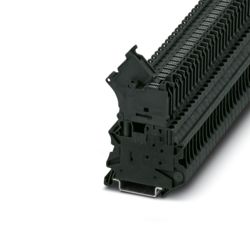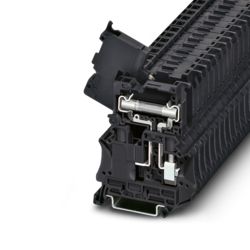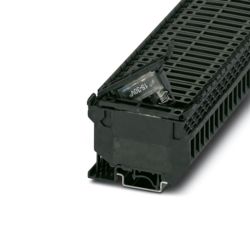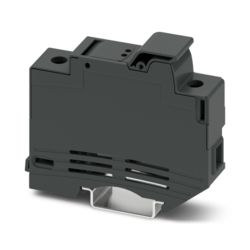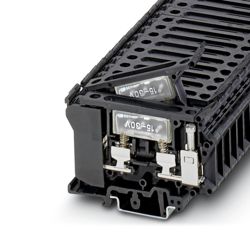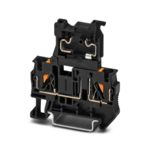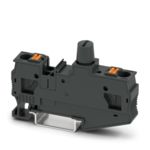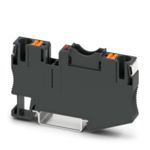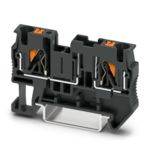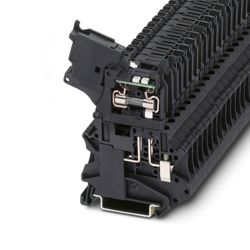
Fuse modular terminal block, fuse type: Glass / ceramics / ..., fuse type: G / 5 x 20, nom. voltage: 24 V, nominal current: 6.3 A, connection method: Screw connection, Rated cross section: 4 mm2, cross section: 0.14 mm2- 6 mm2, mounting type: NS 35/7,5, NS 35/15, color: black
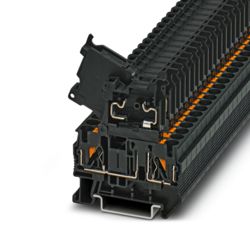
Fuse terminal blocks, component terminal blocks, and diode terminal blocks
Fuse terminal blocks, component terminal blocks, and diode terminal blocks bring important functions directly to the terminal strip. They enable the use of fuses to protect circuits, components to adjust electrical functions, and diodes to control signals in a targeted manner. This makes it easy to implement applications in a clear and reliable way.
Fuse modular terminal block, fuse type: Glass / ceramics / ..., fuse type: G / 5 x 20, nom. voltage: 500 V, nominal current: 6.3 A, number of positions: 1, connection method: Push-in connection, Rated cross section: 4 mm2, cross section: 0.2 mm2- 6 mm2, mounting type: NS 35/7,5, NS 35/15, color: black
Fuse modular terminal block, fuse type: Glass / ceramics / ..., fuse type: G / 5 x 20, nom. voltage: 24 V, nominal current: 6.3 A, number of positions: 1, connection method: Push-in connection, Rated cross section: 4 mm2, cross section: 0.2 mm2- 6 mm2, mounting type: NS 35/7,5, NS 35/15, color: black
Fuse modular terminal block, fuse type: Glass / ceramics / ..., fuse type: G / 6,3 x 32, nom. voltage: 500 V, nominal current: 10 A, number of positions: 1, connection method: Screw connection, Rated cross section: 1.5 mm2, cross section: 0.5 mm2- 16 mm2, mounting type: NS 35/7,5, NS 35/15, NS 32, color: black
Fuse modular terminal block, fuse type: Glass / ceramics / ..., fuse type: G / 5 x 20, nom. voltage: 24 V, nominal current: 28 A, connection method: Push-in connection, 1 level, Rated cross section: 4 mm2, cross section: 0.2 mm2- 6 mm2, connection method: Push-in connection, 2nd level, Rated cross section: 4 mm2, cross section: 0.2 mm2- 6 mm2, mounting type: NS 35/7,5, NS 35/15, color: black
Fuse modular terminal block, fuse type: Glass / ceramics / ..., fuse type: G / 5 x 20, nom. voltage: 250 V, nominal current: 6.3 A, connection method: Screw connection, Rated cross section: 4 mm2, cross section: 0.14 mm2- 6 mm2, mounting type: NS 35/7,5, NS 35/15, color: black
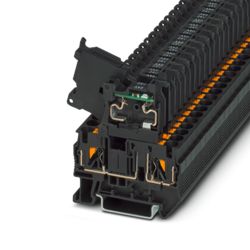
Fuse modular terminal block, fuse type: Glass / ceramics / ..., fuse type: G / 6,3 x 32, nom. voltage: 630 V, nominal current: 10 A, connection method: Screw connection, Rated cross section: 6 mm2, cross section: 0.2 mm2- 10 mm2, mounting type: NS 35/7,5, NS 35/15, color: black
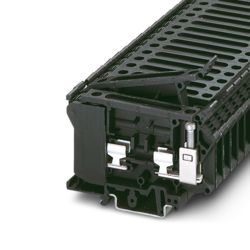
Fuse modular terminal block, fuse type: Glass / ceramics / ..., fuse type: G / 5 x 20 / 5 x 25 / 5 x 30, nom. voltage: 24 V, nominal current: 6.3 A, number of positions: 1, connection method: Screw connection, Rated cross section: 4 mm2, cross section: 0.2 mm2- 4 mm2, mounting type: NS 35/7,5, NS 35/15, NS 32, color: black
Fuse holder, fuse type: Ceramic, fuse type: 10.3 x 38 mm, nom. voltage: 690 V AC, nominal current: 32 A, number of positions: 1, connection method: Screw connection, Rated cross section: 16 mm2, cross section: 1 mm2- 16 mm2, mounting type: NS 35/7,5, NS 35/15, color: black
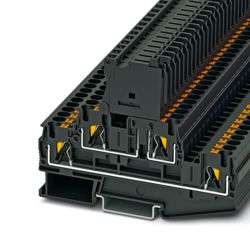
Fuse modular terminal block, fuse type: Glass / ceramics / ..., fuse type: G / 6,3 x 32, nom. voltage: 24 V, nominal current: 10 A, number of positions: 1, connection method: Screw connection, Rated cross section: 1.5 mm2, cross section: 0.5 mm2- 16 mm2, mounting type: NS 35/7,5, NS 35/15, NS 32, color: black
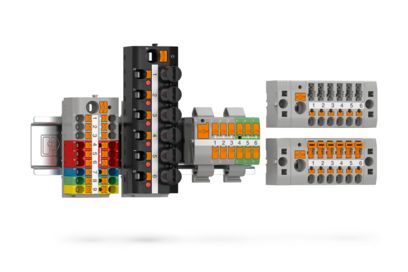
Easily find the right terminal block for you
Fuse terminal blocks
PTV 4-HESI lever-type fuse terminal blocks
Fuse terminal blocks
Fuse terminal blocks enable the easy, safe protection of electrical circuits directly in the terminal strip. Device fuses reliably protect connected components against overloads and short circuits. At the same time, the wiring remains organized and easily accessible at all times.
Your advantages:
- Integrated circuit protection through the direct use of fuses
- Quick fuse replacement without disconnecting the wiring
- A clear layout in the control cabinet for easy maintenance and troubleshooting
Comparison of fuse terminal blocks
This table compares the different models of fuse terminal blocks.
|
|
|
|
|
|
|---|---|---|---|---|
|
Lever-type fuse terminal blocks
(HESI...) |
Screw cap fuse terminal blocks
(DREHSI...) |
Plug-in fuse terminal blocks
(FSI/C) |
Plug-in fuse terminal blocks
(FSI/F) |
|
| Fuse type | Device protection (for example, G/5x20, G/6.3x32... ) | Device protection (for example, G/5x20, G/6.3x32... ) | Flat-type fuses (Type C) and thermal circuit breakers (TCP) | Flat-type fuse (F-type) |
| Operating principle | The fuse is accessible via flip lever | The fuse is accessible via rotating holder | The fuse is inserted from the front | The fuse is inserted from the front |
| Error detection | Lever position clearly visible, optional status indicator (LED) | Limited visibility, optional status indicator (LED) | Depending on the fuse type, optional status indicator (LED) | Good for front-facing installation, optional status indicator (LED) |
| Typical advantages | Maximum user-friendliness | Durable, space-saving solution | Flexibility through standard fuses | Optimal accessibility even with dense wiring |
| Product list | Product list | Product list | Product list |
Component terminal blocks and diode terminal blocks
Component terminal blocks
Component terminal blocks enable the easy integration of electronic components directly into the terminal strip. Resistors or other components can be specifically integrated into the circuit without requiring additional wiring outside the terminal block. This results in functional, well-organized solutions inside the control cabinet.
Your advantages:
- Easy integration of electronic components directly into the terminal block
- Reduced wiring effort with compact functional integration
- Clear, structured implementation of adjustment and signaling functions
Diode terminal blocks
Diode terminal blocks enable the specific integration of diodes directly into the terminal strip. They ensure controlled signal routing, for example, to decouple signals or to prevent feedback in the circuit. This makes it possible to design circuits in a simple, reliable, and well-organized manner.
Your advantages:
- Precise signal control via integrated diodes
- Reliable decoupling and prevention of unwanted feedback effects
- Compact, well-organized integration directly into the terminal strip
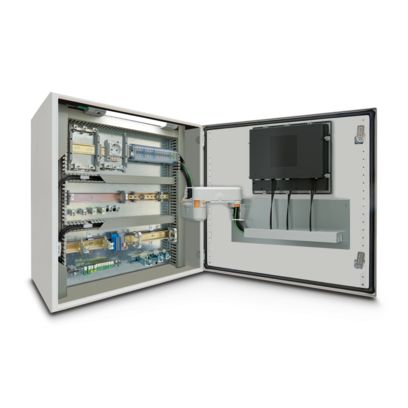
Control cabinet
Still haven’t found the right product?
Feel free to contact us. Together, we'll develop the best solution for equipping your control cabinets. With our CLIPLINE complete terminal block system and other components from the areas of communications and automation, we offer you a comprehensive, futureproof portfolio.
Connection technologies for terminal blocks
Terminal blocks are available with various connection technologies and therefore meet a variety of requirements. Explore the variety of connection technologies and select the right terminal block for your specific needs.
The most comprehensive system for terminal blocks
The CLIPLINE complete terminal block system
The CLIPLINE complete terminal block system provides the opportunity to freely and flexibly combine different terminal blocks using the double function slot. These include feed-through terminal blocks and various function terminals with different connection methods. The system also features standardized bridge, marking, and test accessories. The terminal blocks from the CLIPLINE complete system have been tested and approved for a wide range of national and international approvals. Our free clipx ENGINEER configuration software is available for the quick and effective construction of assembled DIN rails.
Terminal blocks product brochure
Downloads
Would you like to get printed materials about our terminal blocks? Below you will find various brochures on the subject of terminal blocks. In addition to the product brochure, you will find a brochure about the CLIPLINE complete terminal block system and about the quality tests for the terminal blocks.