Controller; Subscription, Network license; application: Virtual control; Programming tool: PLCnext Engineer; Type of software: On-premises; License duration: 12 Months; Basic functions: Virtual control, The VPLCNEXT CONTROL is a powerful, real-time-capable virtual control based on PLCnext Technology.
It is provided as an OCI-compliant container (Open Container Initiative) and can be instantiated flexibly.
Virtual Control
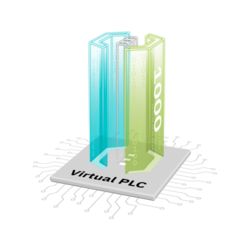
The new Virtual PLCnext Control portfolio offers an innovative solution for industrial automation. It abstracts control tasks from physical devices and executes them on high-performance computers, increasing flexibility, scalability, and cost efficiency. As a software code package in an OCI container, it enables seamless integration, combines OT and IT security, and optimizes costs by consolidating multiple PLC instances.
Controller; Subscription, Network license; application: Virtual control; Programming tool: PLCnext Engineer; Type of software: On-premises; License duration: 12 Months; Basic functions: Virtual control, The VPLCNEXT CONTROL is a powerful, real-time-capable virtual control based on PLCnext Technology.
It is provided as an OCI-compliant container (Open Container Initiative) and can be instantiated flexibly.
Controller; Subscription, Network license; application: Virtual control; Programming tool: PLCnext Engineer; Type of software: On-premises; License duration: 12 Months; Basic functions: Virtual control, The VPLCNEXT CONTROL is a powerful, real-time-capable virtual control based on PLCnext Technology.
It is provided as an OCI-compliant container (Open Container Initiative) and can be instantiated flexibly.
Controller; Network license; application: Virtual control; Programming tool: PLCnext Engineer; Type of software: On-premises; Basic functions: Virtual control, The VPLCNEXT CONTROL is a powerful, real-time-capable virtual control based on PLCnext Technology.
It is provided as an OCI-compliant container (Open Container Initiative) and can be instantiated flexibly.
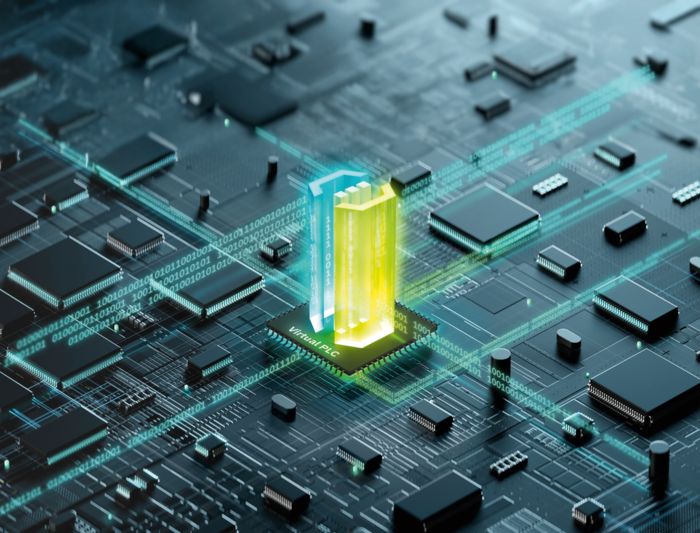
Efficient and flexible control solutions with Virtual PLCnext Control
Virtual controls are playing an increasingly important role in modern industrial automation. This technology enables you to abstract control tasks from physical devices and execute them on high-performance computer architectures, providing flexibility, scalability, and cost efficiency. The Virtual PLCnext Control is a software code package in the form of an OCI container, which provides a familiar environment with functions as well as operating and programming options that will also be known to you from hardware-based PLCnext Control.
This technology allows resources such as CPU cores and RAM to be scaled dynamically while providing seamless IT/OT convergence and a robust combination of OT and IT security. Easy maintenance and the ability to easily move applications between different hardware platforms make Virtual PLCnext Control a cost-effective and flexible solution for modern control tasks.
-
Cost efficiency and energy efficiency: Multiple virtual controllers on a single hardware platform reduce procurement costs and enable new controllers to be added without additional hardware. At the same time, consolidating hardware can reduce energy consumption.
-
Flexibility and scalability: The controllers can be easily adapted and extended to meet new requirements. Resources such as CPU cores, RAM, and network interfaces are scalable. Applications can be seamlessly moved from one piece of hardware to another with container technology.
-
Ease of maintenance: Maintenance work and updates are easily to carry out using proven IT administration mechanisms. The use of containers simplifies management and deployment.
-
Cybersecurity: The combination of IT and OT security measures provides comprehensive protection and the isolated operation of the virtual controls in the container minimizes the risk of security vulnerabilities.
-
Future-proofing and IT/OT convergence: The high degree of adaptability and scalability supports future developments and technologies. IT and OT can converge more effectively. This allows data and processes to be linked and managed more efficiently.
Container-based virtual PLC
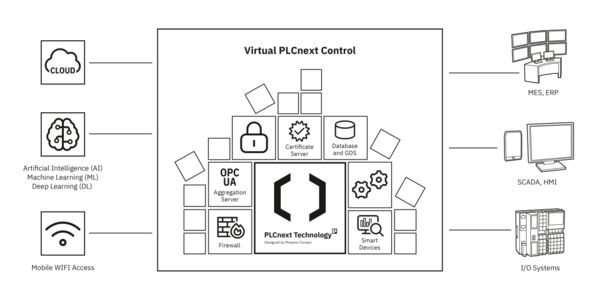
Thanks to container technology and the resulting increasing hardware independence, Virtual PLCnext Control can benefit directly from the interfaces, functions, and performance of the target hardware. For example, connection to the system network via Wi-Fi and deep learning by using the target hardware performance are possible.
Furthermore, Virtual PLCnext Control provides familiar functions from the existing hardware, such as the firewall, the certificate server, fieldbus connections, and even database functions. OPC UA and PROFINET can be used to communicate with the SCADA and control system as well as with the I/O fieldbus level.
Product overview
We will be able to offer you the following licenses in the future. Find the right solution for your application.
|
Virtual PLCnext Control
1000 |
Virtual PLCnext Control
2000 |
Virtual PLCnext Control
3000 |
|
|---|---|---|---|
| ESM | 1 | 2 | 4 |
| Tasks / ESM | 4 | 8 | 16 |
| Number of ARs | 16 | 64 | 128 |
| Cycle time | 1 ms | 1 ms | 1 ms |
| Program memory (only for IEC 61131-3 code) | 4 MB | 8 MB | 12 MB |
| Data storage system (only for IEC 61131-3 code) | 6 MB | 12 MB | 32 MB |
| Modbus/TCP server | 8 | 16 | 32 |
| PROFINET controller / device | |||
| High-level language programming (C# / C++ / Matlab / ...) | |||
| App manager | |||
| Alarming and retaining |
Areas of application
Virtual PLCnext Control offers versatile solutions for various areas of application in industrial automation. Our technology helps companies to optimize their processes, reduce costs, and increase efficiency. In the following, we show three main areas of application and illustrate how Virtual PLCnext Control can meet your automation requirements.
Edge computing
Virtual PLCnext Control brings control functions directly to the data source. This reduces latency compared to cloud solutions and supports Industry 4.0, the IoT, protocol conversion, data acquisition, and cloud computing.
What do you get out of it?
- Real-time data processing: Processing data directly on site reduces latency and improves efficiency.
- Reliability: Real-time monitoring and analysis enable faster responses.
- Industry 4.0 and the IoT: Edge computing facilitates the integration of modern technologies.
Example:
A solar park with Virtual PLCnext Control can increase the efficiency and reliability of its systems. Real-time monitoring and analysis of operating data on-site enable proactive maintenance planning and minimize downtimes. This optimizes energy production and improves the overall performance of the solar park.
Device Manufacturer
Virtual PLCnext Control supports device manufacturers facing modern automation requirements. Real-time automation operates without specialized control hardware. Industry protocols and fieldbus systems make it easier to adapt to various project requirements.
What do you get out of it?
- Cost-efficiency: Less dedicated control hardware reduces hardware costs.
- Integration: Industrial protocols and fieldbus systems can be integrated into existing systems.
- Flexibility: The solution is scalable, customizable, and reduces system complexity.
Example:
An OEM with Virtual PLCnext Control can reduce production costs and increase flexibility. The control functions are integrated directly into the existing hardware, reducing system complexity and increasing efficiency.
Data centers, telecommunications and IT
Virtual PLCnext Control handles control functions on various platforms, including servers in the data center. This simplifies scaling and customization, supports real-time data processing, and reduces downtimes.
What do you get out of it?
- Hardware costs: Virtual controllers reduce the amount of physical hardware and reduce costs.
- Scalability: Virtual machines can be added and removed.
- Maintenance and downtimes: Virtual controllers make maintenance easier. Restarts and replacements can be made quickly.
Example:
A data center with Virtual PLCnext Control can improve operational efficiency and reduce downtimes. The control functions run on servers within the data center. This enables quick recovery and maintenance.