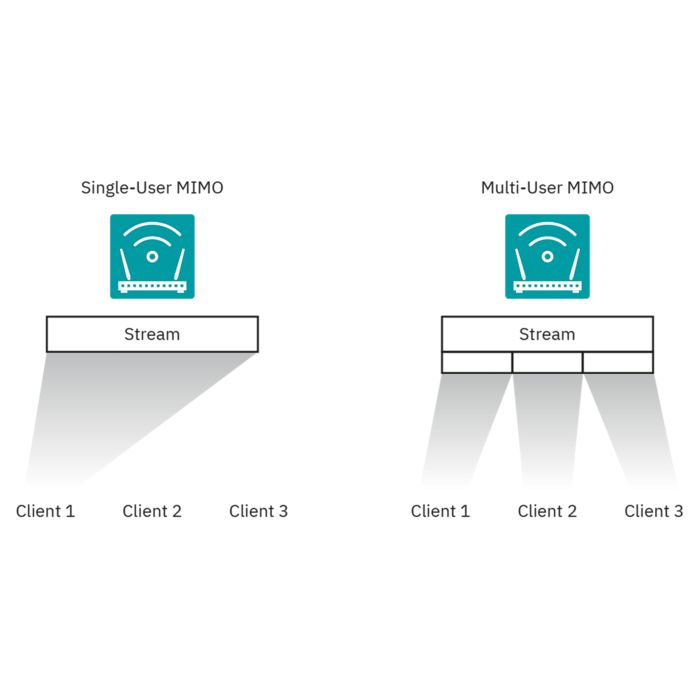
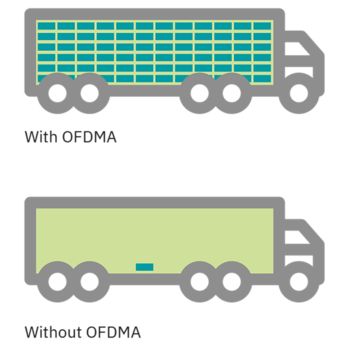


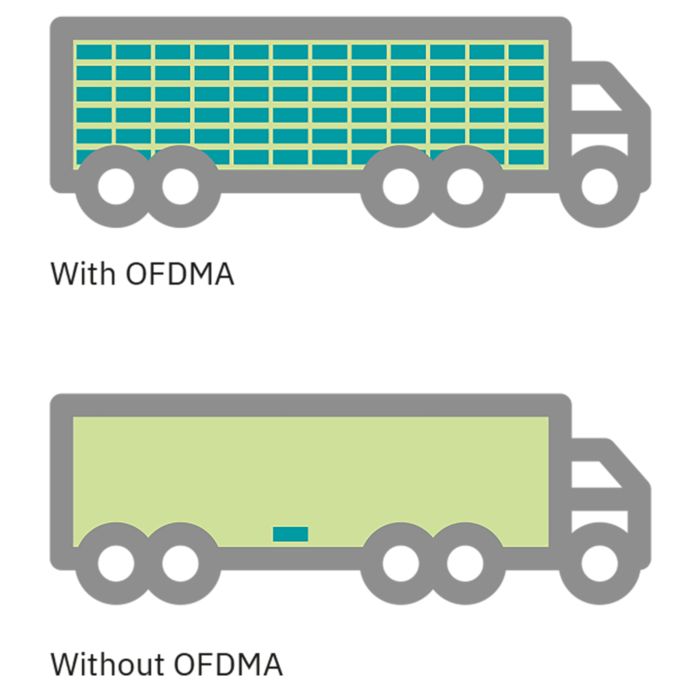
OFDMA (orthogonal frequency-division multiple access) allows the access point to effectively divide channels so that it can communicate with multiple devices (clients) simultaneously on one channel. This technology enables more users to be operated in less time. This significantly improves efficiency and reduces the latency considerably in networks with many devices. The improvement of the overall QoS thus enables the effective use of the bandwidth in an environment with a high WLAN density.
Industrial WLAN Wireless LAN – the standard for wireless Ethernet. Benefit from the advantages of the new generation of Wi-Fi 6/6E in your applications.
Reliability and performance: The Wi-Fi 6/6E WLAN standard
With the advent of Ethernet in automation, Wireless LAN has also become established, especially in moving or mobile applications. The number of WLAN networks and WLAN devices in systems has therefore increased significantly in recent years. To keep pace with this growth, powerful, efficient, and robust Wireless LAN is required. With Wi-Fi 6/6E, a new WLAN technology is now available that brings with it these specific strengths. Wi-Fi 6E in particular offers a solution for real-time-capable and reliable communication by utilizing the new 6 GHz frequency spectrum. This means that up to 59 additional, free transmission channels are available. The full potential of modern Wi-Fi 6 technology can be realized in the 6 GHz band.
Your advantages
- Particularly secure: Meets the highest security standard WPA3
- High efficiency even with many network devices
- High performance with data rates of up to 2,400 Mbps (with 160 MHz channel width)
- Reliable communication in the new 6 GHz band with Wi-Fi 6E (depending on country-specific approvals)
- Fast and reliable roaming for mobile applications
The IEEE 802.11ax standard
Wi-Fi 6, also known as IEEE 802.11ax, is the new standard for wireless networks. Its main features include:
- Higher data transmission rates
- Improved performance in congested environments
- Low latency
- Improved efficiency – system density
- Better real-time properties and performance
Wi-Fi 6 therefore enables efficient use of the frequency spectrum, improves data throughput for all devices in a network, and at the same time ensures flexibility and reliability. The new standard is designed to meet the growing demands for wireless connectivity in an increasingly digital world.
Comparison of WLAN standards Wi-Fi 4 and 6/6E
The introduction of Wi-Fi 6 represents an important milestone in the development of wireless networks and offers a number of improvements over its predecessor Wi-Fi 4:
| Wi-Fi 4 | Wi-Fi 6/6E | |
|---|---|---|
| IEEE standard | IEEE 802.11n | IEEE 802.11ax |
| Security standard | WPA2 | WPA2, WPA3, personal and enterprise |
| Frequency range | 2.4 and 5 GHz | 2.4 GHz, 5 GHz, and 6 GHz (depending on country-specific approvals and product version) |
| MU-MIMO | Download only | Download and upload |
| Maximum transmission speed | 300 Mbps (2x2 MIMO, 40 MHz) | 2,400 Mbps (2x2 MIMO, 160 MHz) |
| Target Wake Time (TWT) | ||
| OFDMA | ||
| BSS coloring |
WLAN in the 6 GHz spectrum: Wi-Fi 6E
Wi-Fi 6E opens up the new, virtually unused 6 GHz band and brings all the benefits of Wi-Fi 6 to this additional frequency range. Specifically, this means wider channels, significantly less interference, and therefore higher transmission speeds and better performance. Since older Wi-Fi generations (Wi-Fi 1 - 5) do not support the 6 GHz band, Wi-Fi 6E devices benefit from an exclusive, low-interference frequency range with minimal utilization and extremely low latency for fast, instantaneous data transmission.
Functions of Wi-Fi 6 and Wi-Fi 6E
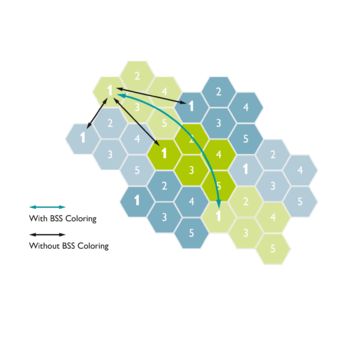
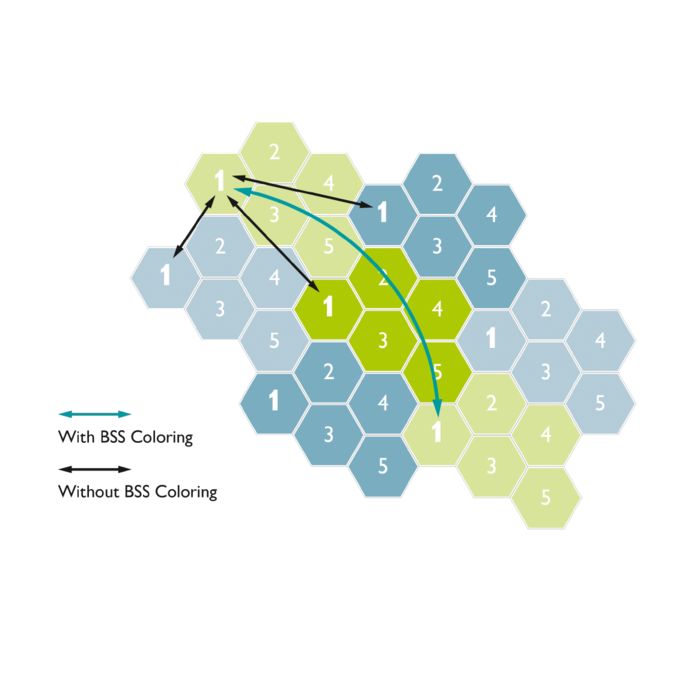
Thanks to the spatial reuse function with basic service set (BSS), channels that are close to each other can be used more efficiently and interference can be reduced. BSS is a technique used to distinguish between signals from different WLAN devices on the same channel by marking them with color codes (or numbers). This means that several devices can use the same channel without interfering with each other.
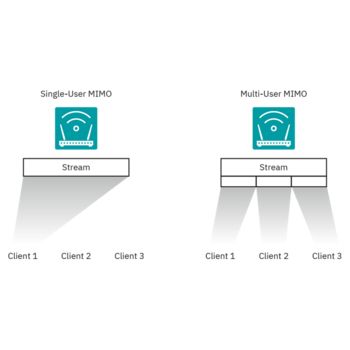
MU-MIMO (multi-user, multiple-input, multiple-output) is a technology that enables an access point to operate several devices simultaneously instead of one after the other. By splitting all available spatial streams across multiple devices, large data packets can be processed more efficiently. This significantly improves the performance of the network, especially in high-density environments.
The WPA3 security standard improves the security of wireless networks by adding additional layers of security. To ensure secure communication in open networks, WPA3 is increasingly supported by Wi-Fi 6-capable devices.
TWT (Target Wake Time) enables devices to define specific times for communication with the access point. This means that a device remains inactive until it is time to transmit data to the access point. This function helps to extend the runtime of battery-operated devices or to save power.
Automatic roaming by mobile devices in the WLAN network
Roaming – mobility in the network
One of the greatest strengths of WLAN is its mobility. Devices can move freely around the network and automatically connect to the access point that offers the strongest signal.
For industrial applications in particular, it is crucial that roaming works quickly and reliably. With our WLAN solutions, switching between wireless cells takes less than 100 ms.
Your advantage: Uninterrupted communication and maximum performance, even in large WLAN networks with many moving devices
Application examples WLAN can be used in a wide range of industrial applications. The increasing need for communication for process and operating data, as well as the increasing mobility of many applications, requires the use of wireless network communication.
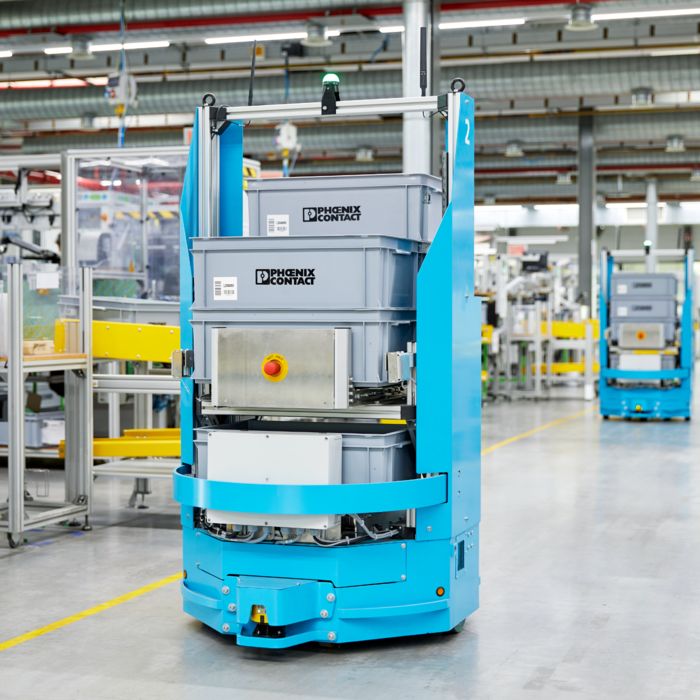
Autonomous vehicles are increasingly being used in the smart factory to optimize production processes. Wi-Fi 6 provides a wireless infrastructure for guaranteeing reliable communication between the AGVs and other networked devices. This enables them to navigate through the production hall more efficiently, for example.
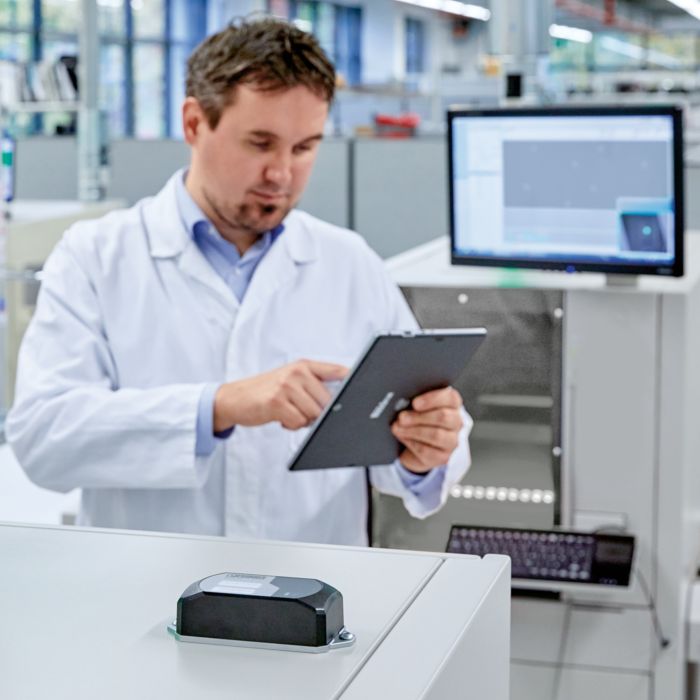
In the smart factory, flexibility is becoming increasingly important. In order to make processes as efficient as possible, machines and production systems must support flexible use in different locations. Connecting machines to the production network enables mobile operation, setup, and maintenance via digital end devices and thus provides the flexibility needed in the smart factory. Wi-Fi 6 offers consistently high and stable data rates, as well as a network that enables fast data transmission, even with many devices.
Benefit from all the opportunities provided by Industrial Ethernet which allows you to integrate mobile and hard-to-access machine parts into your network via wireless communication: Easier and more cost-effective wireless network development, low-maintenance and wear-free communication with moving machine parts and in harsh industrial environments, secure wireless communication via SafetyBridge or PROFINET and PROFIsafe.