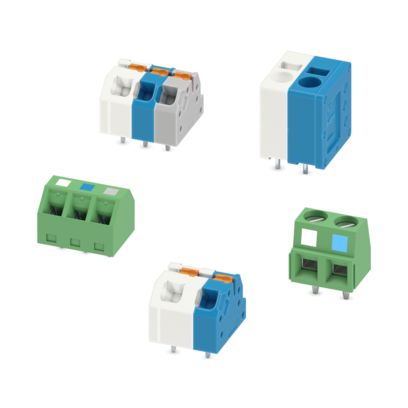
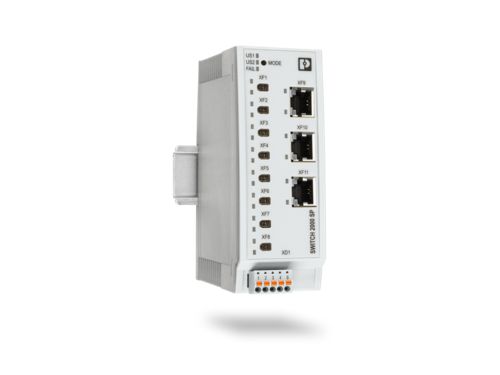


SPE in accordance with the IEC 63171-7 standard ensures true cross-manufacturer compatibility for the first time and reduces planning risks for your company.


In the automation pyramid, classic Ethernet already connects the upper levels, but it is often too complex or has limited range for the lowest field level. SPE technology expands Ethernet's performance capabilities in this area.
Single Pair Ethernet is a physical layer for data transmission using only one twisted-pair cable instead of the two double wires used in Fast Ethernet (100 Mbps) or the four double wires used in Gigabit Ethernet. This enables compact devices, sensors, and actuators to be connected directly from the field level—without the need for additional subsystems or gateways. SPE is therefore the lightweight and material-saving Ethernet enhancement for many current and future applications.


SPE in accordance with the IEC 63171-7 standard ensures true cross-manufacturer compatibility for the first time and reduces planning risks for your company.
IP20 and M12 connectors are expected in early 2027. We recommend that you start planning now. There are plans to convert other designs to the new standard.
Phoenix Contact is the initiator and active co-designer of the new standard – you benefit from our experience and innovative strength.
The new pin connector pattern simplifies integration, increases compatibility, and enables even more flexible use in numerous applications.
At this time, current SPE products will not be discontinued. A decision on this matter will not be made until the new portfolio has been fully implemented.
Yes, our solutions are designed so that you can use existing and new products flexibly and in parallel in your systems.

Overview of the relevant standards for Single Pair Ethernet
The performance of SPE depends on clearly defined standards and specifications. This white paper shows how international regulatory frameworks lay the foundation for a seamless, interoperable, and future-proof SPE infrastructure. The SPE standards are defined in IEEE 802.3. This standard describes the technical framework for Ethernet-based data transmission via one wire pair. The differences are in transmission rates and distances. IEC 63171 describes the compatible connectors for these SPE standards. IEC 63171-7, Edition 2, is currently under development.
IEC 63171-7 Edition 2 builds on the existing hybrid SPE interface. It defines a uniform pin connector pattern that consistently supports both hybrid and purely data-driven applications. The standard distinguishes between a variety of designs, each of which is suitable depending on the application and protection requirements. They include, among other things, IP20 pin connector patterns for use in protected environments, as well as rugged M8 and M12 variants for the field level.
In addition to data transmission via Ethernet, SPE technology also enables the simultaneous power supply of end devices. With Power over Data Line (PoDL), an effective output of up to 52 W can be transmitted.
The various performance classes are described in the IEEE 802.3bu and IEEE 802.3cg standards. With this technology, it is possible to supply power to a sensor or actuator up to 1,000 m away with the cable used for data transmission. This minimizes the installation effort and space required for field cabling.

PoDL performance classes





Whether heat and cold, moisture and dust, or shock and vibrations – the demands placed on data connectors in agricultural machinery are extreme. To achieve maximum reliability even under high loads, Phoenix Contact offers robust connectors for long-lasting, stable, and high-performance SPE data transmission. As a member of the Agricultural Industry Electronics Foundation (AEF), we promote the development of new data transmission standards such as High-Speed ISOBUS (HSI) and support these with our products for Single Pair Ethernet.

The integration of sensors plays a key role in all manufacturing areas. SPE reliably integrates sensors, actuators, and field devices into an existing Ethernet environment. This means that the necessary data and process information can be transmitted directly to the control level or to a cloud for analysis. As opposed to fieldbus protocols, Ethernet can be used in every level of automation. There is no need for additional gateways or interfaces. The reduction to a single wire pair also simplifies the cabling of sensors directly in machines or systems. The construction, operation, and maintenance of systems become more efficient and cost-effective.

This space-saving technology is perfect for applications in the automotive industry. With transmission rates from 10 Mbps to 1 Gbps over just one twisted wire pair and a maximum cable length of 15 m (unshielded) or 40 m (shielded), it is ideally designed for use in vehicle cable harnesses. In addition, there are a number of new SPE standards under development that are expected to make data transfer rates up to 10 Gbps and even higher possible. In new generations of vehicles, SPE will therefore replace CAN, MOST, FlexRay, and other bus systems. Safety functions, control, and communications run uniformly via Ethernet. This is an essential prerequisite for connected or autonomous driving.

Ethernet APL enables the direct two-wire Ethernet connection of field devices and sensors in the ex zones of processing applications. Advanced Physical Layer (APL) uses the 10BASE-T1-L standard of the IEEE 802.3cg along with the IEC TS 60079-47, 2021-03 (2-WISE) standard (2-WISE = 2-Wire Intrinsically Safe Ethernet), and supports explosion protection methods including intrinsic safety. Use in potentially explosive areas and bridging long distances up to 1,000 m at 10 Mbps are both possible. The new communication infrastructure ensures consistent Ethernet use in the process industry.

Networked buildings ensure high efficiency, increased security, and additional convenience functions. By using an end-to-end IP protocol, sensors, switches, and thermostats, for example, can be connected to the building management system via the local data network and the cloud. The consistent SPE cabling replaces existing fieldbus systems, complex interfaces, and gateways. There is also the option to reuse existing two-wire cable infrastructures such as network cables. This makes installation and commissioning significantly easier.
Phoenix Contact has come together with other leading technology companies to form the SPE System Alliance. The partner companies are bundling their Single Pair Ethernet expertise and ensuring the target-oriented exchange of this knowledge, thus pursuing the common goal of promoting SPE technology for the Industrial Internet of Things (IIoT) and all other areas of application.