Innovative charging technology from a single source
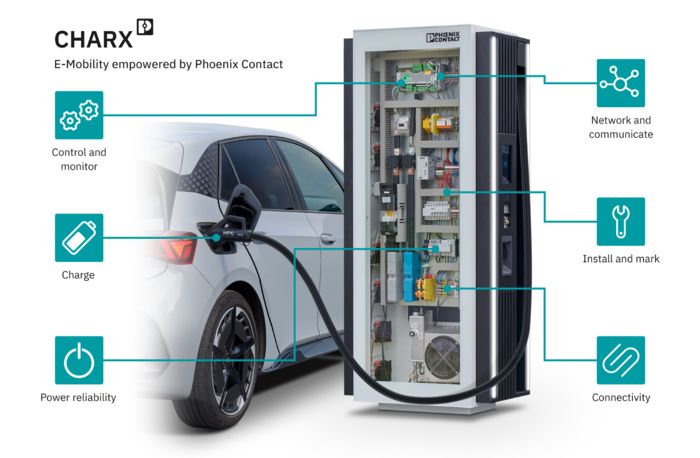
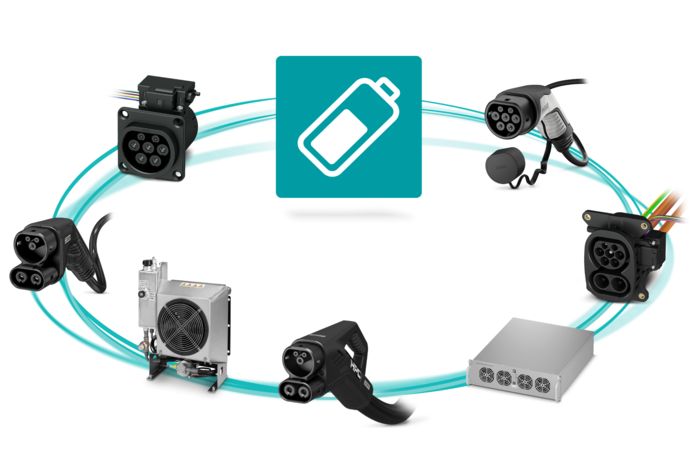
Equip your charging points with CHARX from Phoenix Contact: As a component manufacturer, we supply all the equipment for your charging infrastructure – whether an AC home charger, DC fast charging station, or HPC charging park, whether in PCB, DIN rail, or 19" rack mounting. Our broad portfolio – from CCS charging cables through to load management – forms the basis for a high-performance charging network for electric cars.
Your advantages
Why Phoenix Contact is the right choice
We will assist you in developing your charging infrastructure project: with a broad portfolio, professional product selection and engineering consultation, practical application examples, and expert know-how. If needed, we will also develop customer-specific solutions or even new technologies. We are there for you worldwide, also in your vicinity.
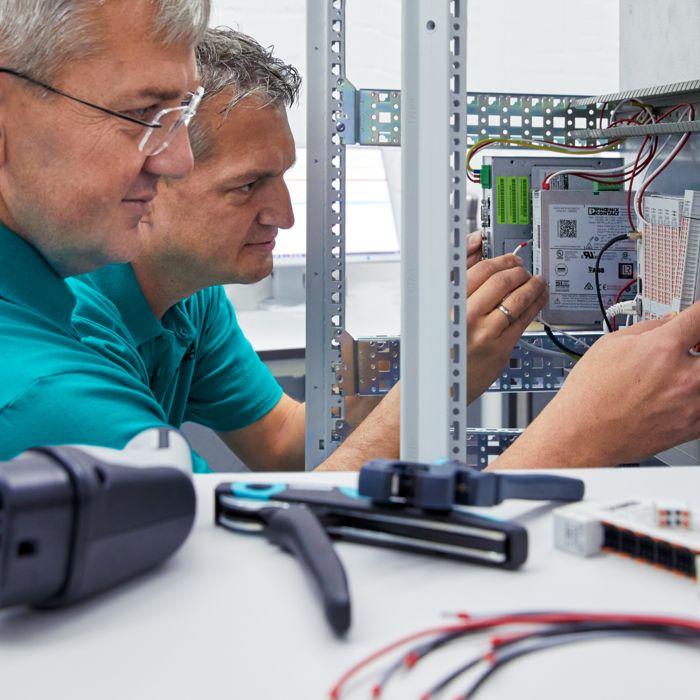
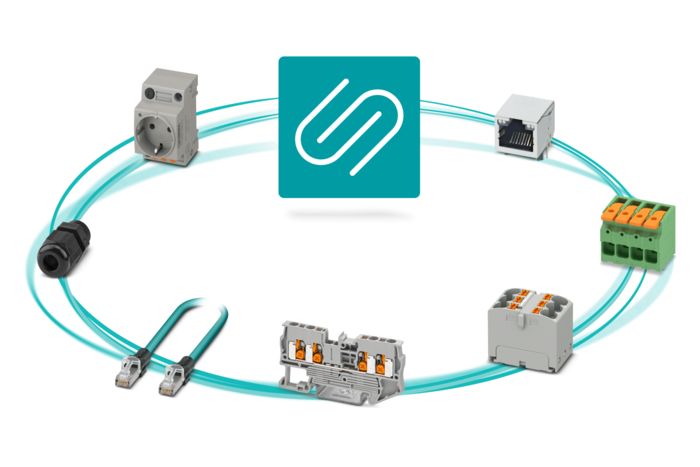
The uniform, modular product design and tool-free connection technologies such as Push-in and Push-X allow you to install and wire the components in the charging station in a quick, convenient, and space-saving way. A special panel feed-through ensures easy installation of the HPC charging cable. With maintenance-friendly and replaceable product components you are going to save both time and money during service works.
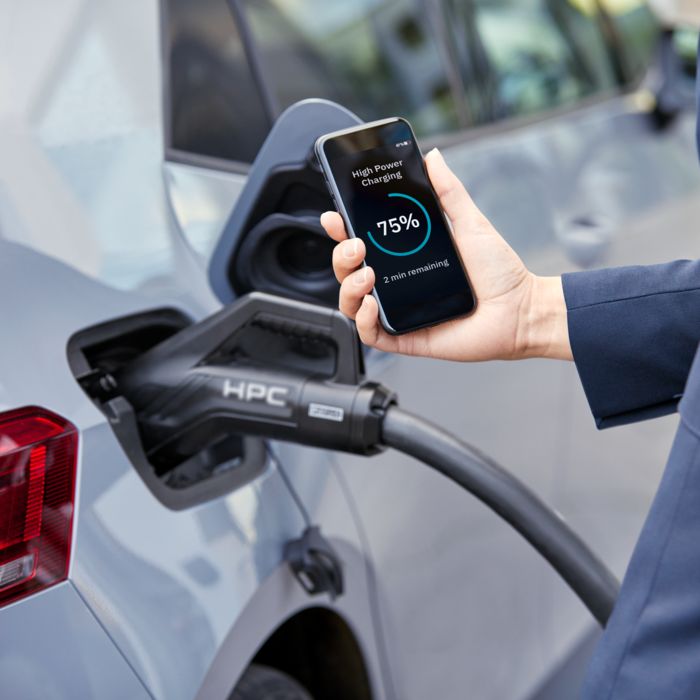
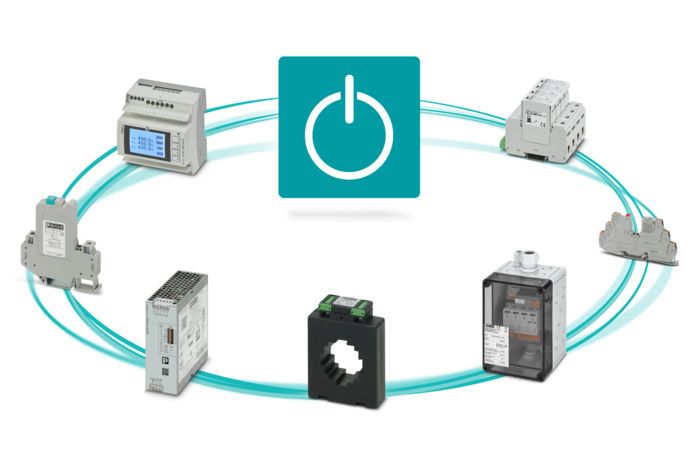
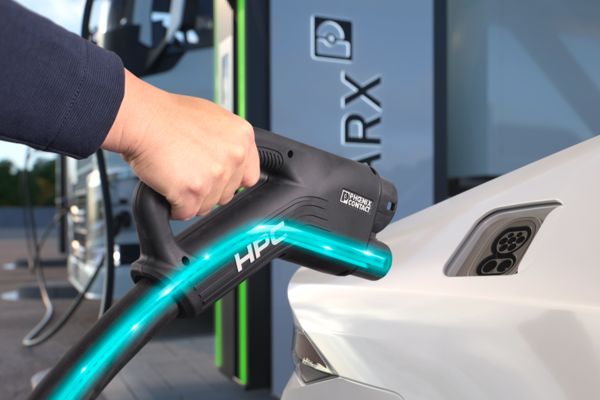
As the pioneers of fast charging technology we develop future-oriented technologies like High Power Charging (HPC) and, with that, enable short charging times that are suitable for everyday use. Reliable charging connection systems and charging controllers as well as high-performance power supplies, protective devices, and cybersecurity products guarantee safe, economic 24/7 operation of your charging infrastructure.
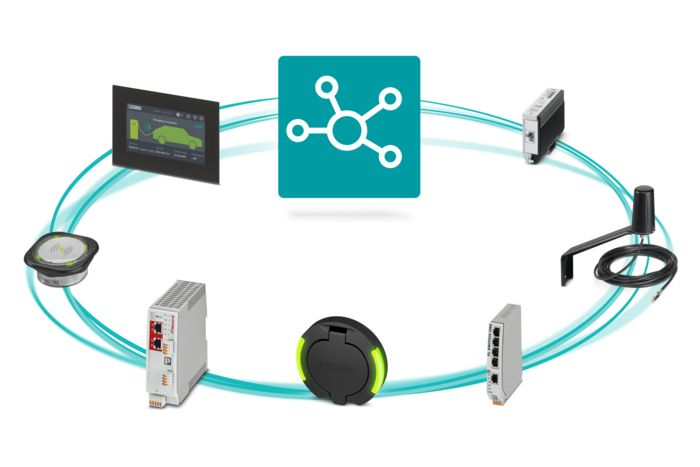
Network your charging points with communicative products, open standard protocols, and established interfaces such as Modbus/TCP, REST, MQTT, or OCPP (Open Charge Point Protocol). Implement a convenient controlling and transparent monitoring of your charging park inclusive of load management, as well as a seamless connection to building management and backend systems. Charging connector status and usage data allow preventive planning of maintenance when it comes to wear and tear.
Depending on the number, charging power, and scope of functions of your charging points, you can choose the appropriate product combination from our scalable portfolio. With modular charging controllers and power electronics as well as graded software licenses and over-the-air updates, you are well prepared for future developments and extensions of your charging park.
Pure e-mobility is a key factor on the path to the All Electric Society. A convenient and carbon-neutral charging process not only requires a fast charging network for electric vehicles, but also coupling with other sectors. With our high-performance and intelligent CHARX products, we will ready you for the e-mobility of the future – sustainable, networked, and practical.
Discover our broad portfolio
Our products cover all functional areas of modern charging stations
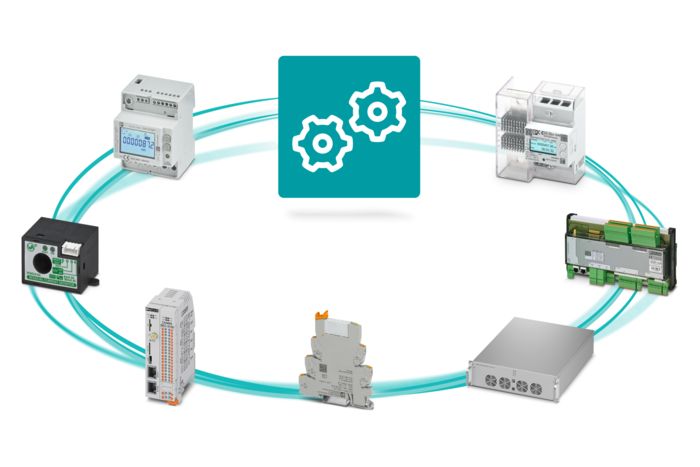
Control and monitor
How do I optimally control and monitor the charging process?
References
Find out how we are driving the mobility transition forward with our customers and partners
The Italian company Alpitronic is one of the leading providers of DC fast-charging solutions and is setting standards in terms of power, efficiency, and flexibility with its Hypercharger series. Our liquid-cooled CCS and MCS charging cables are used in the HYC 400 EV charging station and the flexible, decentral HYC 1000 charging system. With innovative cooling technology, these enable ultra-fast and safe charging with up to 1,000 kW.
With SICHARGE FLEX, Siemens has launched a modular high-performance charging system for buses, trucks, and fleets. The platform provides up to 1.68 MW of charging power and supports the CCS and MCS charging standards. Phoenix Contact supplies the right charging cables for all power levels – including innovative water-glycol cooling and ergonomic cable handles for optimum handling and particularly high operational safety.
SBOW iFlex offers a mobile and autonomous solution for setting up charging infrastructure at any location, even without a grid connection. With CCS charging cables, CCS charging inlets, power electronics, and control and relay technology from Phoenix Contact, ultra-fast charging with up to 240 kW is possible. Our battery pole connectors guarantee reliable power transmission to the integrated battery storage system.
With the LichtBlick FlexiCharger Pro, the German company LichtBlick offers a mobile charging solution for demanding areas of application such as construction, logistics, and industry. Up to 150 kW charging power, in the future also 500 kW, a modular design and easy maintenance ensure maximum availability. Phoenix Contact supplies CCS charging cables, power electronics, charging controllers, surge protection, and connection technology - for particularly high reliability and flexibility.
Bavarian company RZB ENERGY based in Bamberg, Germany, combines lighting solutions with modern charging technology. The modular products consist of a standpipe, charging container, and luminaire head or cover plate. Several charging stations are often used in combination. A client-server network compliant with calibration laws and boasting up to twelve charging points saves costs. AC charging controllers and AC charging sockets from Phoenix Contact are used.
The charging infrastructure solution from PLUON is a customizable system for sustainable mobility – individually designed as well as ecologically and locally produced. The patented modular system enables a long service life due to replaceable components. Equipped with AC charging controllers, energy meters, RFID readers, and other components from Phoenix Contact, PLUON combines technology, design, and sustainability.
The largest PV charging park in northern Germany, built by Pramux and operated by ferry operator Frisia, charges the electric vehicles of vacationers while they are visiting the North Sea islands. Phoenix Contact uses intelligent charging management to ensure that the vehicles are recharged with sustainably generated PV electricity by the time they return. The AC charging controllers communicate with the charging park’s higher-level control system and the billing system.
e-RS is a Belgian provider of complete e-mobility charging solutions. The company’s aim is to offer an integrated, centrally controlled solution for charging parks. In the project shown here, 120 charging points were installed, which can be expanded to up to 800 charging points. Central control cabinets with AC charging controllers, switching devices, and energy meters from Phoenix Contact are used, enabling efficient control and monitoring.
German family-owned company hesotec electrify not only focuses on quality and design, but also sustainability. With its timeless designer EV charging stations made of stainless steel, the company offers recyclable AC charging solutions for sophisticated requirements – from both a visual and technical point of view. Our multi-award-winning designer charging cables CHARX connect comfort and our charging sockets CHARX connect modular are the perfect match.
German company GP Joule specializes in renewable energies and has equipped its on-site charging park with an intelligent load and energy management system. The objective: to charge the company’s fleet of 28 electric cars, making optimum use of self-generated biogas and solar power. Everything is controlled via a central control cabinet equipped with AC charging controllers, energy meters, and software from Phoenix Contact.
Swiss company Evtec relies on bidirectional charging for its new DC EV chargers. This allows the electric vehicle to be charged via self-generated solar power and for power to be fed back into the building at night. Our CCS charging cables CHARX connect compact, which were developed specifically for DC charging in the home environment with lower charging powers of up to 80 kW, are used here.
Ingeteam is a company empowering e-mobility – and not just in Spain, where the company has been working toward an electrified future for the past twelve years. At a traffic junction in southern Spain, Ingeteam’s fast charging stations form southern Europe's largest HPC charging park. With a total rated output of 4 MW, a vehicle can be charged in around five minutes. The company uses the CHARX connect professional HPC charging cables from Phoenix Contact for this.
Together with BMW, Porsche, Siemens, and Allego, we have developed, created, and launched the world’s first HPC EV charging station with a charging power of 450 kW as a part of the FastCharge research project. To promote widespread acceptance of e-mobility, the project demonstrated that ultra-fast charging works in practice. We supplied our liquid-cooled HPC charging cables CHARX connect professional, as well as the control technology for this project.
With a mission to provide green energy for all, everywhere, Italian company E-GAP is present in several major European cities. With the mobile on-demand fast charging service, electric car owners are supplied with the amount of energy requested via app. The modular charging system in the E-GAP vans enable AC and DC charging with up to 80 kW and is equipped with charging technology, energy meters, and connection technology from Phoenix Contact.
With CHARX, our charging solutions can be used flexibly in different environments in charging parks. We can use it to offer our growing customer base a complete solution, from analysis, planning, and implementation, all the way to operation.
From a EV charger to a fast charging park
Our scalable portfolio allows you to realize any charging solution
The company
Charging opportunities for employees, guests, and the vehicle fleet require load management and are often integrated into the building and energy management system. The typical charging powers here are 22 kW AC and 150 kW. Operation is usually via a central terminal with user authorization. The billing of charging processes and remote maintenance of the charging stations can be implemented as an option.
Towns and municipalities
A comprehensive charging network in urban areas serves to reduce emissions and thus improve the quality of life. The typical charging powers here are 22 kW AC and 150 kW DC. User authorization, billing of charging processes, and remote maintenance of the charging points are required. A touch panel or buttons can be integrated into the charging stations for operation as an option.
Hotels, shops, and restaurants
Charging opportunities provide added value for guests and promote customer loyalty, especially if charging is offered free of charge. Due to the longer duration of their stay, charging is usually performed with 11 or 22 kW AC. For customers who are in a hurry, DC charging with, e.g., 50 kW can be offered as an option. A load management system is required in the case of multiple charging points. Various billing and remote maintenance options as well as integration into the building management system round out the charging solution.
Rental apartments
Charging stations for tenants usually offer 11 kW AC. So as not to overload the building connection, an energy management system is used in the case of multiple stations. Direct billing of individual charging processes is not necessary if the electricity consumed is read on separate energy meters and paid via the annual service charge settlement. To prevent electricity theft, however, it makes sense to restrict access or authorize users.
Private residential buildings
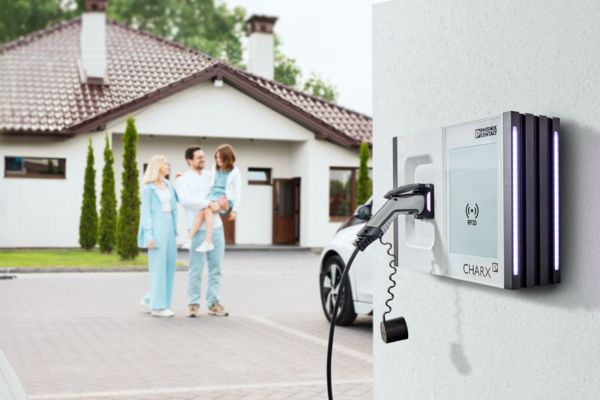
Home chargers for garages and carports usually charge with 11 kW AC. However, there is also a trend towards DC chargers with 22 kW, which can use the direct current of a photovoltaic system with only minimal conversion losses. As an option, the EV charger can be integrated into a smart home system to which the photovoltaic system and energy storage system are also connected. This enables intelligent, PV-optimized charging.
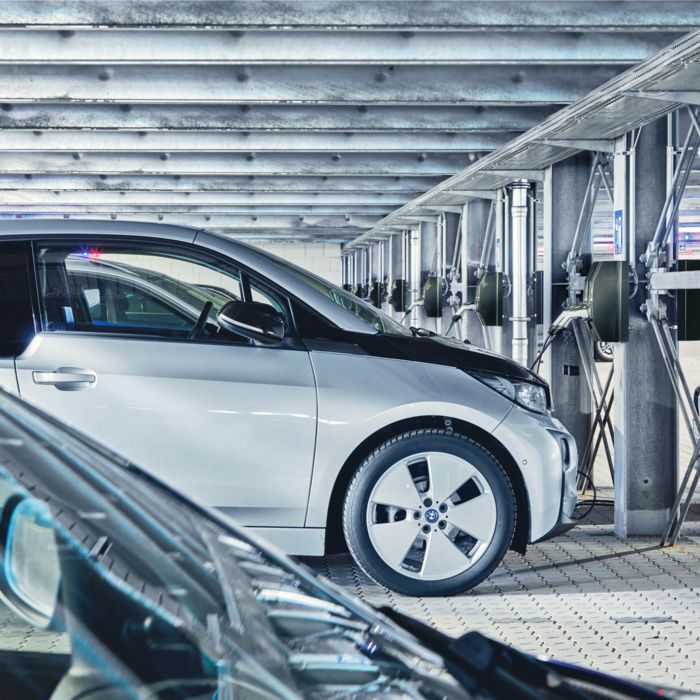
Parking lots and parking garages
There are several charging points in a small space and an operator terminal for user authorization. Charging is typically performed with 11 to 22 kW AC and optionally with DC. Functions such as dynamic load management, precise billing of charging processes, and the option of remote maintenance in the event of faults are essential for smooth operation. Integration into an energy management system also makes sense if there are other loads in the building or there is a photovoltaic system on the roof.
Vehicle fleets
When it comes to the fast charging of passenger, transport, and utility vehicles, the focus is on cost-effectiveness and thus the capacity utilization and tight scheduling of the vehicles. This requires short charging times and high charging powers of typically 22 kW AC and 400 kW DC. User authorization, load management, remote maintenance, and building integration are required for safe, reliable, and smart operation.
Fast charging parks, service stations, and rest areas
These public charging stations are usually located on highways and main transport hubs and offer High Power Charging (HPC) with up to 400 kW DC to enable fast onward travel after a few minutes of charging. Each charging station has its own screen for convenient operation. Authorization and billing are performed via an app, charge card, or credit card. Dynamic load management and remote diagnostics are essential for safe and reliable 24/7 operation.
We are here to support you
Professional consultation and customization
We will provide you with personal and fast support for your project:
Advice on selecting suitable products for your charging solution
Production of charging connectors and charging sockets with your individual logo – for the consistent branding of your charging stations
Charging cables assembled to suit your installation requirements – with tailored cable lengths, stripping lengths, and step cuts, either crimped or compacted
Development of customer-specific applications and new technologies where needed
Your personal contact person
For all queries regarding our products and solutions
I will be happy to advise you on your charging infrastructure project.
Phoenix Contact E-Mobility
Your powerful and reliable partner
We have been the specialist for e-mobility charging technology within the Phoenix Contact Group since our founding in 2013. With approximately 800 employees worldwide and 33,200 m² of production space, our portfolio includes over 700 CHARX products for expanding charging infrastructure and for the electrification of utility vehicles and mobile machinery.
As a pioneer and co-inventor of CCS fast charging, a market leader in liquid-cooled HPC charging cables, and a key player in international standardization, we are driving the global transition to sustainable mobility. Our mission is to develop charging technology that is high-performance, reliable, networked, and ready to meet the demands of tomorrow.
Key player in global standardization
Together with IEC, DKE, and CharIN, we are accelerating the mobility transition
We are driving the electrification of the transportation sector – not only as a manufacturer of charging technology, but also as a trusted key player and active contributor to global standardization efforts.
As a leader of international project teams at the IEC and the German mirror committees within the DKE, we connect industry, testing institutes, and infrastructure partners, actively help shape the specifications for new charging standards, and accelerate the path to international standardization.
Alongside leading automobile manufacturers and the TÜV SÜD certification body, we were one of the founding members of the Charging Interface Initiative (CharIN) in 2015. Today, with more than 300 members, CharIN is the world’s leading association advocating for unified charging standards such as CCS, NACS, and MCS.
Through our global sales subsidiaries, we secure acceptance within national standardization organizations, establish our results on a global scale, and build trust in safe, interoperable charging.