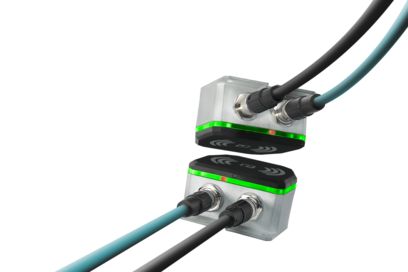
NearFi Technology NearFi is a contactless real-time transmission technology from Phoenix Contact. It allows the transmission of power and data across an air gap of a few centimeters. With protocol-independent and latency-free Ethernet communication, it offers flexible application options for all Ethernet protocols up to 100 Mbps.


Real-time communication with NearFi
Full duplex for real-time Ethernet
NearFi enables simultaneous data transmission in both directions (full duplex). This is an essential requirement for modern real-time Ethernet protocols. The use of two parallel 60 GHz connections (uplink and downlink) ensures stable, lossless communication at all times. This results in maximum performance for demanding industrial applications.
Your advantages:
- Full duplex communication for true real-time capability
- Supports current and future Ethernet protocols
- Stable and high-performance data transmission
- No limitations due to half duplex transmission or timing conflicts
- Ideal for highly dynamic industrial applications

Interference-free communication using 60 GHz technology
Powerful 60 GHz technology
NearFi uses modern 60 GHz wireless technology that was specifically developed for short distances and high data rates. The range is intentionally limited to a few centimeters. This enables targeted, controlled, and interference-free communication.
Coexistence without interference: Thanks to local near-field transmission, NearFi does not interfere with existing wireless technologies such as WLAN or Bluetooth. At the same time, the system itself remains immune to electromagnetic interference, even in demanding industrial environments. Multiple NearFi systems can be operated in parallel without interfering with one another.
Your advantages:
- Efficient, directional transmission without signal loss
- No wireless overload or performance drops
- High data rate for real-time applications
- Increased security through locally contained signals
- No frequency planning or specialized knowledge required

Bit-oriented transmission is latency-free
Bit-oriented transmission
NearFi relies on synchronous, bit-oriented transmission. Data is transmitted directly, without any detours, and without any packet-based intermediate steps. While traditional wireless technologies cause delays due to storage, packing, and unpacking, NearFi transmits data continuously and without latency. This enables real-time communication without delays, resulting in high efficiency and performance.
Your advantages:
- Minimal latency through direct data transmission
- Instant real-time processing of Ethernet data
- Supports all common protocols, such as EtherCAT, PROFINET, and EtherNet/IP
- Greater efficiency without packet-related overhead
- Stable and deterministic data flow
- Ideal for time-critical industrial applications

Inductive power transmission via a magnetic field
Inductive power transmission
NearFi enables inductive power transmission without any physical connection. Intelligent control ensures stable and constant power transmission at all times, even during movement or under changing conditions. Depending on the application, power can be scaled flexibly or even transmitted at separate voltages. This allows for flexibility while ensuring a high level of operational safety.
Your advantages:
- Contactless power transmission with no wear and tear
- Consistent performance across the entire operating range
- Flexible scaling up to 50 W or up to 100 W in parallel operation
- Reliable operation even when subjected to motion and vibration
- Maintenance-free and durable

Reduced attack surface through physically limited, non-IP-based data transmission
Cybersecurity – secure from the ground up
With NearFi, security does not result from additional software complexity; rather, it is already built into the transmission principle. Communication that is intentionally limited to the local area and is not IP-based minimizes the potential attack surface and avoids the typical vulnerabilities of traditional network systems. This enables secure, stable, and easily integrable data transmission without the need for traditional IT security measures.
In summary, by doing away with traditional network layers, a completely new, clearly defined security approach emerges.
Your advantages:
- Minimal attack surface due to local, non-IP-based communication
- Security directly at the physical level – without additional protection mechanisms
- No configuration required for the network, IT, or protocols
- High reliability due to robust, low-interference transmission
- Easy to integrate and ideal for secure, future-proof applications