
CBMC E4 24DC/1-4A S-R
-
Electronic circuit breaker
1065727
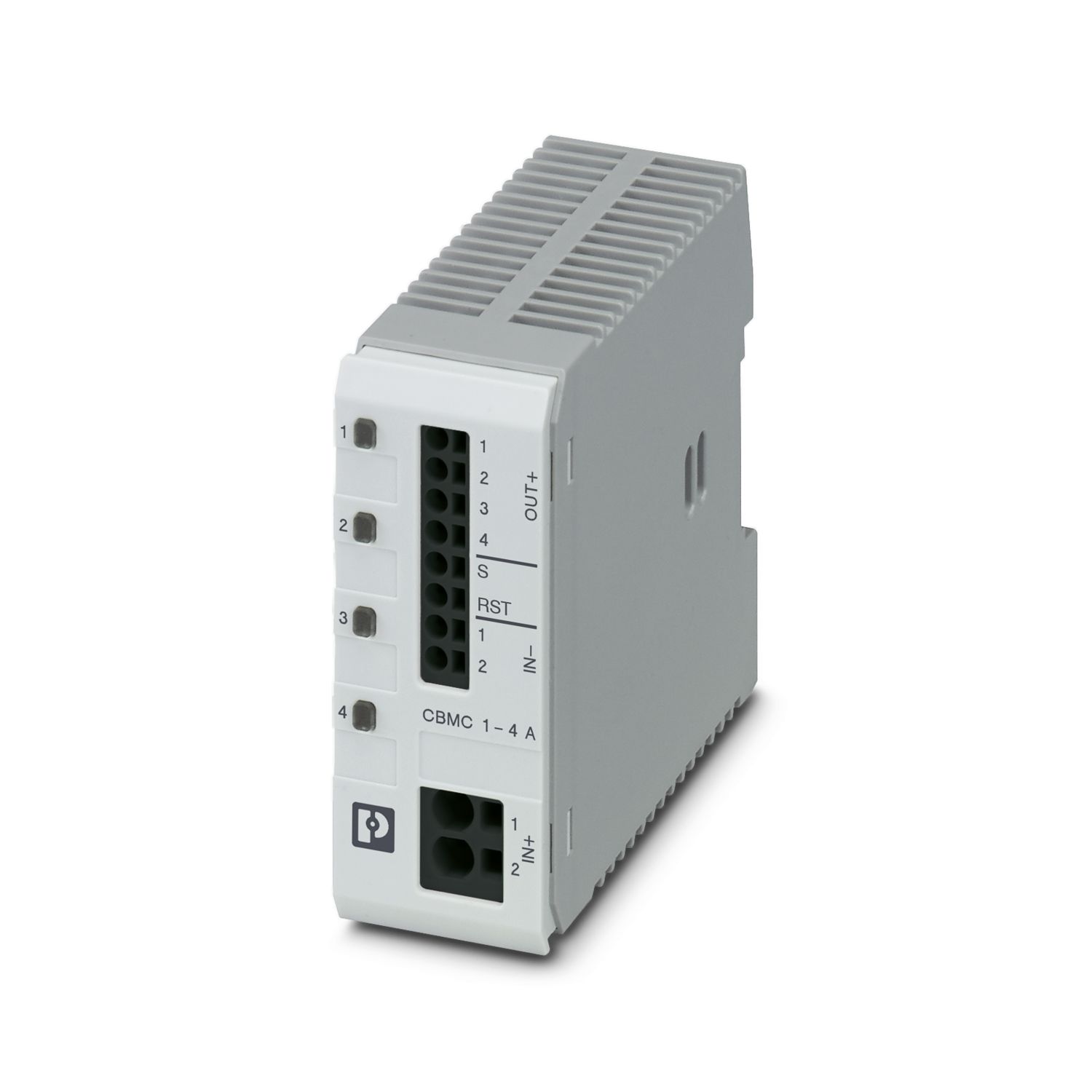
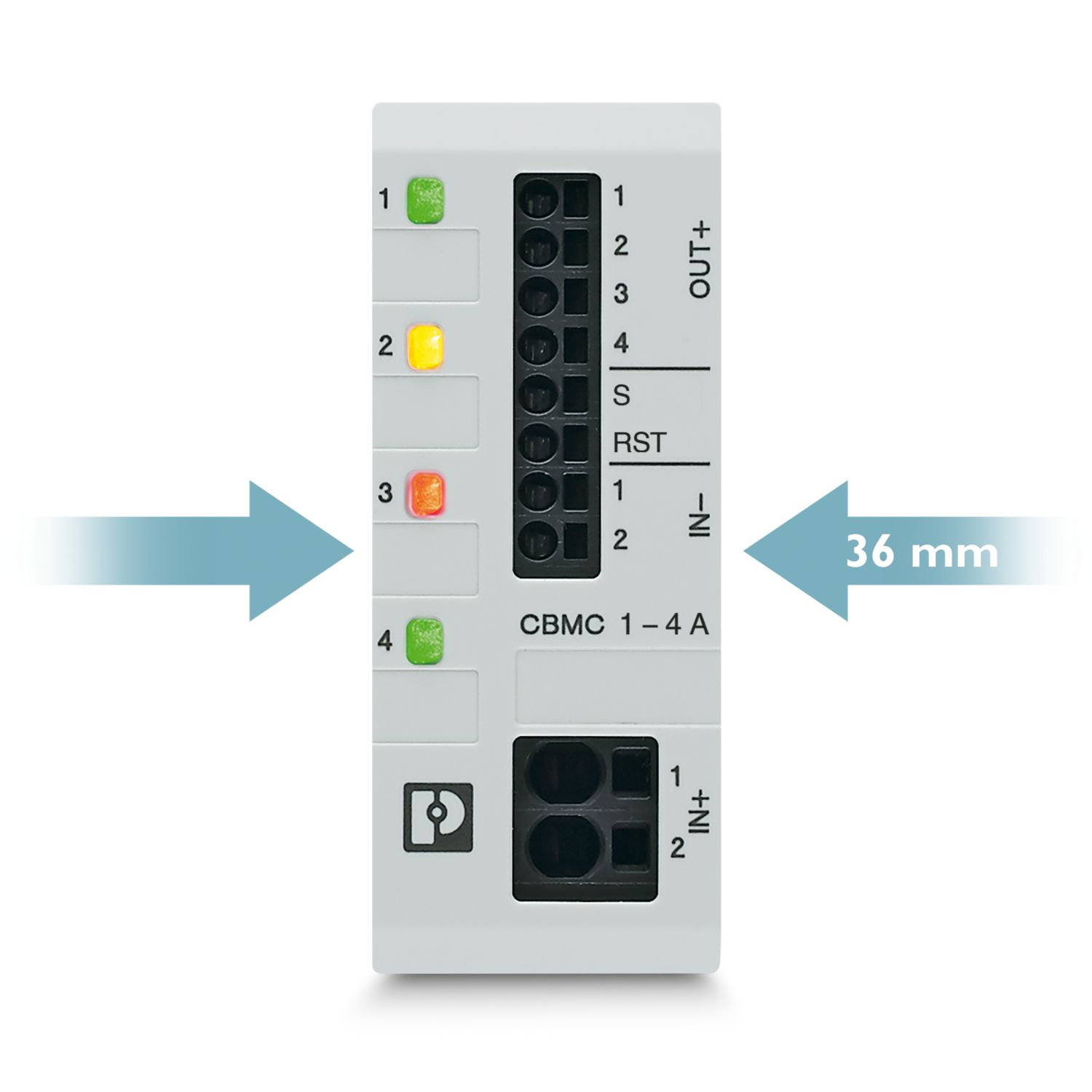
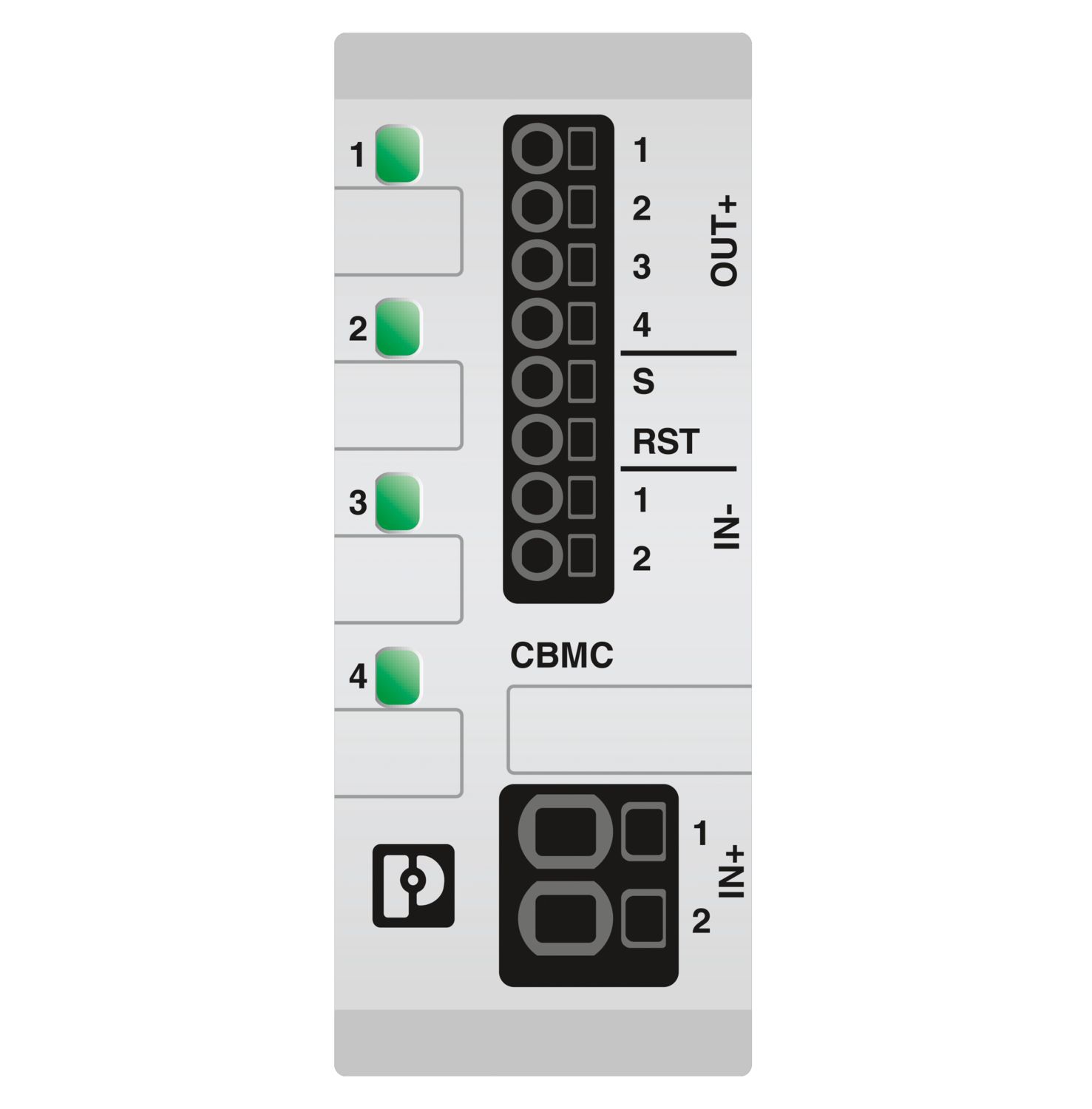
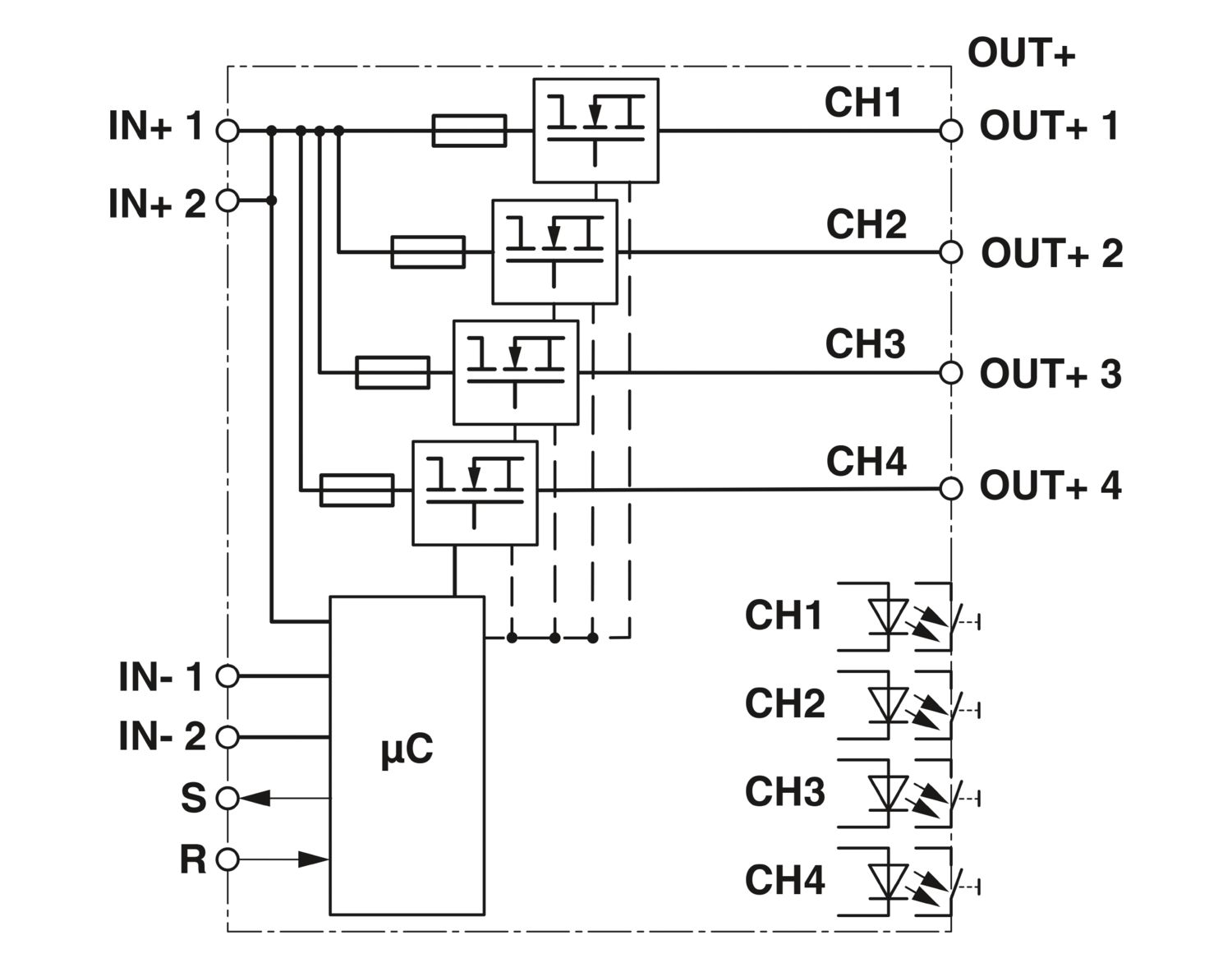
Multi-channel electronic circuit breaker for protecting four loads at 24 V DC in the event of overload or short circuit. With status output, reset input, and electronic locking of the set nominal currents. For installation on DIN rails.
Product details
| General | |
| Note | Repeated hard short circuits can reduce the melting integral of the integrated backup fuse. |
| Always connect the negative pole to terminal IN- to ensure the internal power supply. Return currents from the loads must not be fed back to the power supply via IN- of the circuit breaker. | |
| Product type | Device circuit breakers |
| Product family | CBMC |
| Type | DIN rail module, one-piece |
| Number of positions | 1 |
| No. of channels | 4 |
| Insulation characteristics | |
| Protection class | III |
| Pollution degree | 2 |
| General | |
| Operating voltage | 18 V DC ... 30 V DC |
| Rated voltage | 24 V DC |
| Rated current IN | max. 16 A (IN+) |
| max. 40 A (per terminal position when bridging additional devices via IN+) | |
| Rated current IN | 1 / 2 / 3 / 4 A DC (adjustable per output channel) |
| Rated current (pre-adjusted) | 4 A |
| Rated surge voltage | 0.5 kV |
| Tripping method | E (electronic) |
| Feedback resistance | max. 35 V DC |
| Required backup fuse | Only required if Imax of the power supply > the short-circuit switching capacity. Integrated failsafe element. |
| Short-circuit switching capacity | 300 A |
| Dielectric strength | max. 35 V DC (Load circuit) |
| Fuse | electronic |
| Efficiency | > 99 % |
| Closed circuit current I0 | typ. 25 mA |
| Power dissipation | typ. 0.6 W (No-load operation) |
| < 4 W (Nominal operation) | |
| Module initialization time | 1.6 s |
| Waiting time after switch off of a channel | 5 s (at overload / short circuit) |
| Measuring tolerance I | ± 15 % |
| MTBF (IEC 61709, SN 29500) | 11764705 h (at 25 °C with 21 % load) |
| 5319148 h (at 40°C with 34.25% load) | |
| 846023 h (at 60°C with 100% load) | |
| Fail-safe element | 4 A DC (per output channel) |
| Contact switching type | without electrical isolation |
| Load circuit | |
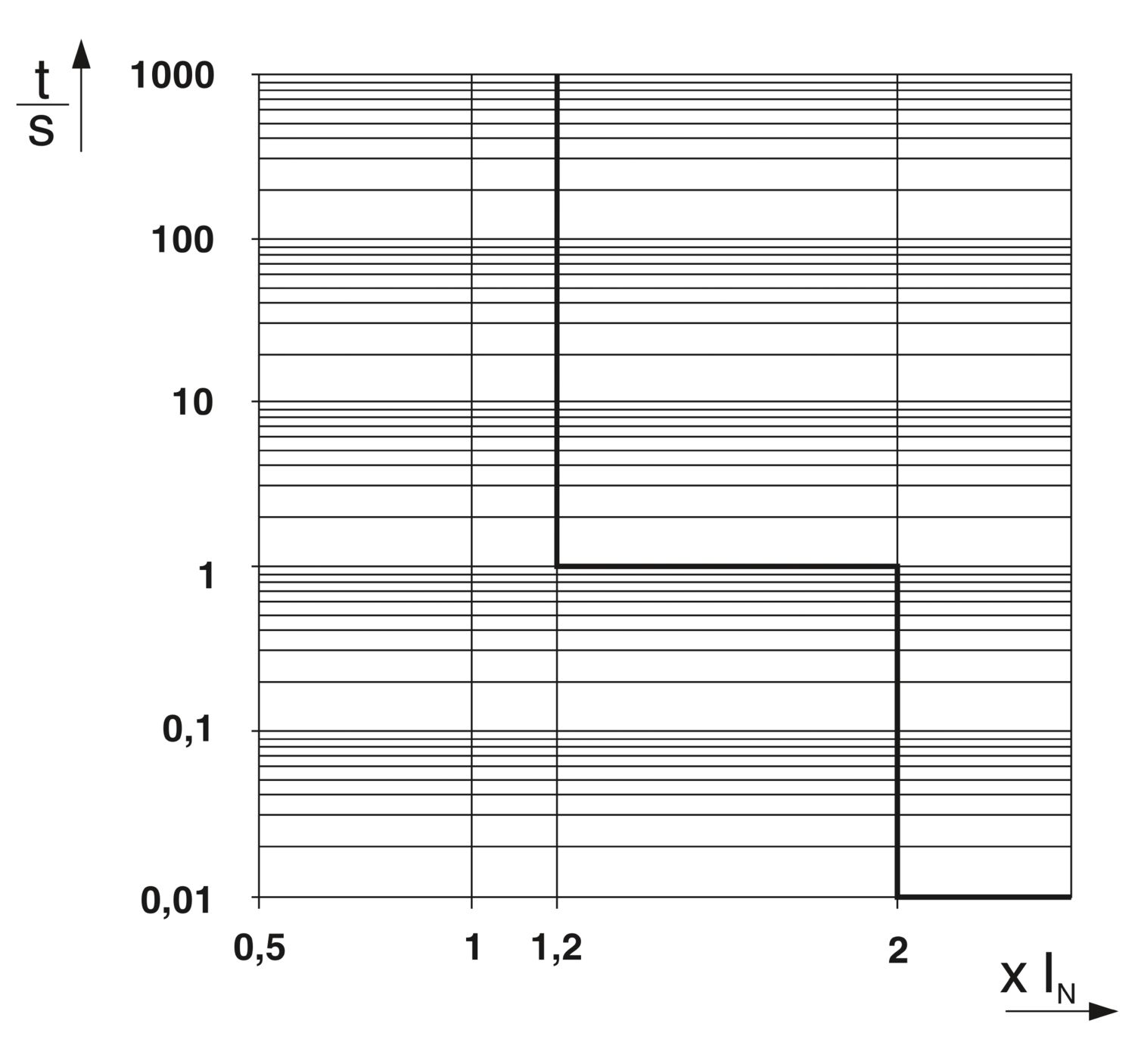
| Shutdown time | ≤ 10 ms (for short circuit > 2.0 x IN) |
| 1 s (1.2 ... 2.0 x IN) | |
| Undervoltage switch-off | ≤ 17.8 V DC (active) |
| ≥ 18.8 V DC (inactive) | |
| Overvoltage switch-off | ≥ 30.5 V DC (active) |
| ≤ 29.5 V DC (inactive) | |
| Max. capacitive load | 30000 µF (Depending on the current setting and the short-circuit current available) |
| Switch-on delay | 0.1 s (per output channel) |
| Reset | |
| Input voltage range | 7 V DC ... 30 V DC (Reset with falling edge) |
| Current consumption | typ. 0.4 mA (at 24 V DC) |
| Pulse length | ≥ 50 ms (High) |
| ≥ 50 ms (Low) | |
| Voltage | < 5 V DC (Low state) |
| > 8 V DC (High state) | |
| Stripping length | 10 mm |
| Conductor cross-section rigid | 0.2 mm² ... 2.5 mm² |
| Conductor cross-section AWG | 24 ... 12 |
| Conductor cross-section, flexible, with ferrule, with plastic sleeve | 0.25 mm² ... 1.5 mm² |
| Conductor cross-section, flexible, with ferrule, without plastic sleeve | 0.25 mm² ... 2.5 mm² |
| Status output | |
| Output voltage | 24 V DC |
| Output current | max. 0.04 A (Short-circuit-proof) |
| Stripping length | 10 mm |
| Conductor cross-section rigid | 0.2 mm² ... 2.5 mm² |
| Conductor cross-section AWG | 24 ... 12 |
| Conductor cross-section, flexible, with ferrule, with plastic sleeve | 0.25 mm² ... 1.5 mm² |
| Conductor cross-section, flexible, with ferrule, without plastic sleeve | 0.25 mm² ... 2.5 mm² |
| Main circuit IN+ | |
| Connection method | Push-in connection |
| Stripping length | 15 mm |
| Conductor cross-section flexible | 0.2 mm² ... 6 mm² |
| Conductor cross-section rigid | 0.2 mm² ... 10 mm² |
| Conductor cross-section AWG | 24 ... 8 |
| Conductor cross-section, flexible, with ferrule, with plastic sleeve | 0.25 mm² ... 4 mm² |
| Conductor cross-section, flexible, with ferrule, without plastic sleeve | 0.25 mm² ... 6 mm² |
| Main circuit IN- | |
| Connection method | Push-in connection |
| Stripping length | 10 mm |
| Conductor cross-section rigid | 0.2 mm² ... 2.5 mm² |
| Conductor cross-section AWG | 24 ... 12 |
| Conductor cross-section, flexible, with ferrule, with plastic sleeve | 0.25 mm² ... 1.5 mm² |
| Conductor cross-section, flexible, with ferrule, without plastic sleeve | 0.25 mm² ... 2.5 mm² |
| Main circuit OUT+ | |
| Connection method | Push-in connection |
| Stripping length | 10 mm |
| Conductor cross-section rigid | 0.2 mm² ... 2.5 mm² |
| Conductor cross-section AWG | 24 ... 12 |
| Conductor cross-section, flexible, with ferrule, with plastic sleeve | 0.25 mm² ... 1.5 mm² |
| Conductor cross-section, flexible, with ferrule, without plastic sleeve | 0.25 mm² ... 2.5 mm² |
| Channel LED off | off (Channel switched off) |
| Channel LED yellow | lit (Channel switched on, channel load > 80% ) |
| flashing (Programming mode active) | |
| Channel LED green | lit (Channel switched on) |
| Channel LED red | lit (Channel switched off, over- or undervoltage active) |
| ON temporarily (Channel switched off, 5 s cool-down phase, overload or short-circuit release) | |
| flashing (Channel switched off, ready to be switched back on, overload or short-circuit release) | |
| two flashes (Channel switched off, device total current limit 40 A exceeded) |
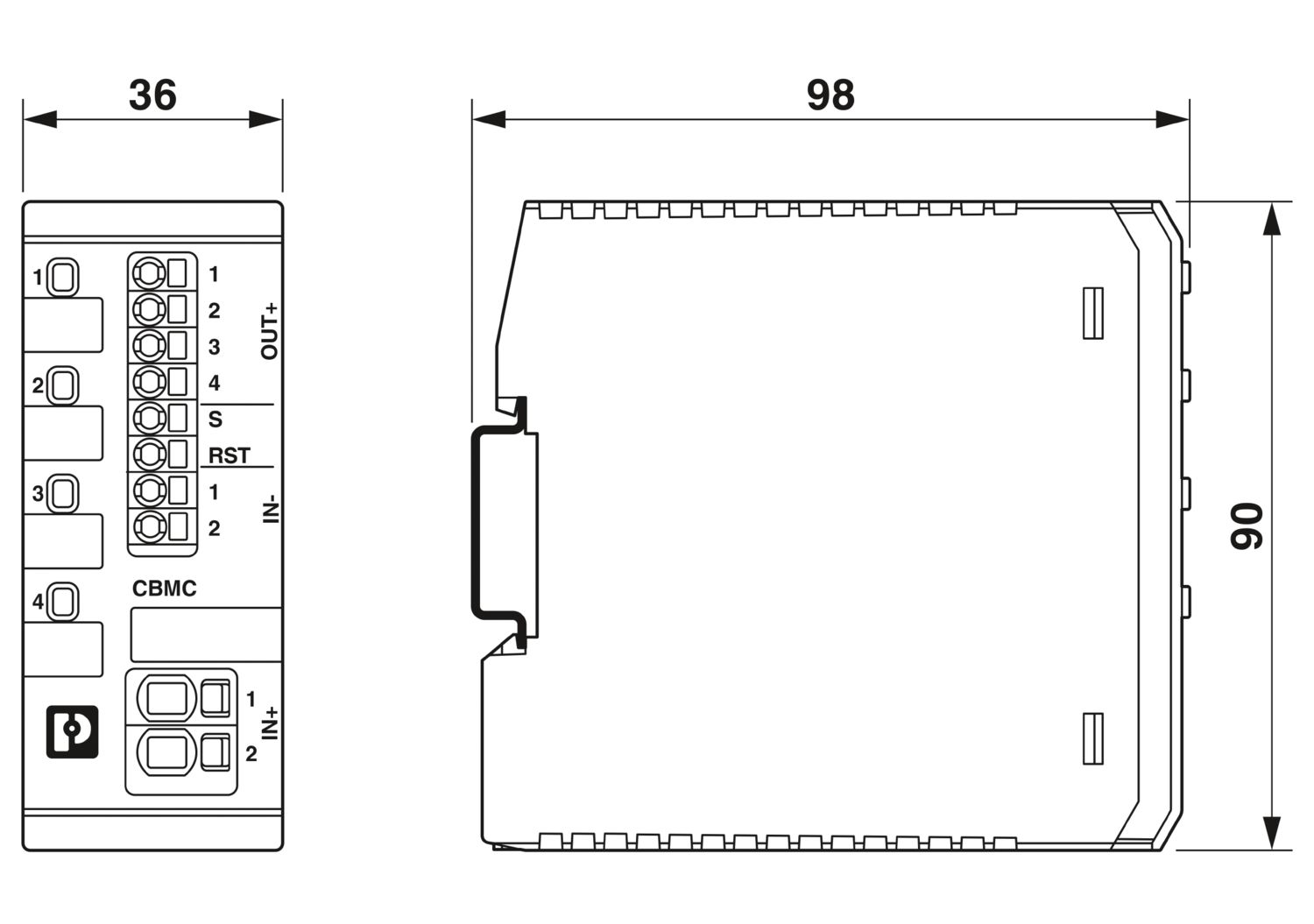
| Dimensional drawing |
|
| Width | 36 mm |
| Height | 90 mm |
| Depth | 98 mm (incl. DIN rail 7.5 mm) |
| Color | light gray (RAL 7035) |
| Material | PC |
| PA 6.6 | |
| PA 6.3T | |
| POM | |
| Flammability rating according to UL 94 | V-0 |
| Ambient conditions | |
| Degree of protection | IP20 |
| Ambient temperature (operation) | -25 °C ... 60 °C |
| Ambient temperature (storage/transport) | -40 °C ... 70 °C |
| Altitude | ≤ 3000 m up to 52 °C (amsl) |
| ≤ 4000 m up to 46 °C (amsl) | |
| Humidity test | 96 h, 95 % RH, 40 °C |
| Shock (operation) | 30g (IEC 60068-2-27, Test Ea) |
| Vibration (operation) | 10 Hz ... 57.6 Hz (Amplitude ±0.35 mm; in accordance with IEC 60068-2-6, Test Fc) |
| 57.6 Hz ... 150 Hz (Acceleration 5g; in accordance with IEC 60068-2-6, Test Fc) | |
| UL approval | |
| Identification | UL/C-UL Listed UL 508 |
| UL Recognized UL 2367 | |
| NEC Class 2 according to UL 1310 | |
| Corrosive gas test | |
| Identification | ISA S71.04.2013 G3 Harsh Group A |
| Standards/specifications | EN 61000-6-2 |
| Note | EMC – Immunity for industrial areas |
| Standards/specifications | EN 61000-6-3 |
| Note | EMC – Emission for residential, business and commercial properties and small operations |
| Standards/specifications | EN 60068-2-6 |
| Note | Environmental influences – Vibrations (sinusoidal) |
| Standards/specifications | EN 60068-2-27 |
| Note | Environmental influences – Shocks |
| Standards/specifications | EN 60068-2-78 |
| Note | Environmental influences – Moisture and heat, constant |
| Standards/specifications | EN 50178 |
| Note | Equipping power installations with electronic equipment |
| Mounting type | DIN rail: 35 mm |
Your advantages
Easy device replacement without replanning, thanks to compact design and options for individual adjustments
Circuits can be adjusted without any tools by means of one single pushable LED button
Enhanced diagnostic and control options, thanks to integrated status output and reset input
Optimum protection for cables and sensors as well as NEC Class 2 circuits by means of an additional internal output fuse
Reliable protection against unintentional adjustment of current values, thanks to electronic locking
Status LEDs in traffic light colors enable instantaneous determination of operating states
Frequently asked questions
Is there a hardware tutorial that explains the functions of the CBMC?
How do you set the nominal current on the CBMC?
1. Start the programming mode by pressing the LED button for > 2 seconds. The LED shows the set nominal current via a yellow flashing rhythm, e.g., 4 flashes for 4 A.
2. Set the required nominal current by pressing the button several times, e.g...
View more
1. Start the programming mode by pressing the LED button for > 2 seconds. The LED shows the set nominal current via a yellow flashing rhythm, e.g., 4 flashes for 4 A.
2. Set the required nominal current by pressing the button several times, e.g., 3 x for 3 A, then this is indicated by 3 x flashing.
3. Press the channel button for > 2 seconds to confirm the new current value.
If there is no confirmation, the channel exits programming mode after 60 seconds.
How do I connect the CBMC and what are the special features of the feed-in?
The CBMC has Push-in connection terminal blocks, simply press the wire with ferrule into the connection terminal block. To release the wire, push a suitable screwdriver into the actuation shaft and remove the wire.
The IN+ and IN- connections are ...
View more
The CBMC has Push-in connection terminal blocks, simply press the wire with ferrule into the connection terminal block. To release the wire, push a suitable screwdriver into the actuation shaft and remove the wire.
The IN+ and IN- connections are used to supply the CBMC, the IN- terminal block is smaller as it is only used to supply the CBMC, the load currents must not flow back via the CBMC. This minimizes a possible voltage drop across the line. The IN+, on the other hand, must carry the total current of all subsequent load currents.
What signals does the CBMC offer?
There are different versions of the CBMC, with 13-14 potential-free contacts or with reset input and status output.
NO - potential free remote contact 13-14
This indicates the status of the system. If there is at least one fault shutdown, ...
View more
There are different versions of the CBMC, with 13-14 potential-free contacts or with reset input and status output.
NO - potential free remote contact 13-14
This indicates the status of the system. If there is at least one fault shutdown, it issues a message.
closed = there is no fault
open = there is at least one fault shutdown
S - Status output
Potential-bound collective signal, this indicates the status of the CBMC. If there is at least one fault shutdown, it outputs a message.
High (24 V) = there is no error
Low (0 V) = there is at least one error shutdown
Maximum current 20 mA
RST - reset input
Channels that have been switched off due to an error are switched on again via a falling edge.
Do the outputs of the CBMC meet the NEC Class 2 requirements?
The CBMC circuit breakers, which can be set up to a maximum of 4 A, have four NEC Class 2 outputs. This means that they supply a maximum of 100 VA at the output and therefore meet the requirements of NEC Class 2 and cables and devices can therefore be used without UL approval.
Does the CBMC provide electrical isolation?
The CBMC is also available in a version with galvanic isolation. In this case, the circuit is switched off by a MOSFET and additionally via a relay, the output is then potential-free.
The designation of this variant begins as follows:
CBMC EG4...