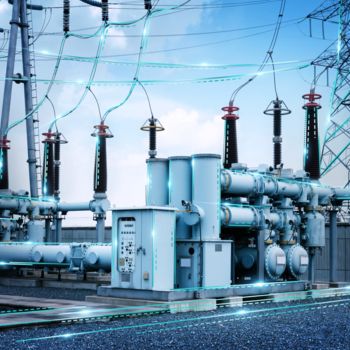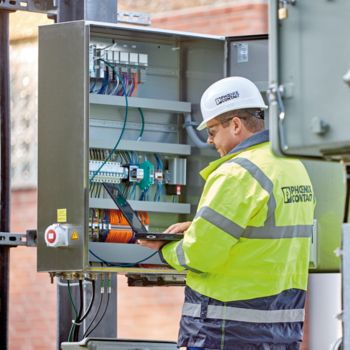








The forward-thinking DC technology at Phoenix Contact enables the sustainable feed-in, storage, and distribution of renewable energy. Discover our DC solutions for safe DC grids.
Innovative DC technology for more sustainability right now
Sustainability is more than a buzzword – it has always been our mission.
Join Phoenix Contact on the way to a world with renewable energy that is efficiently stored and distributed. This will make electrical energy available for use anytime, anywhere. This is why at Phoenix Contact, we focus on concepts and solutions for the safe use of DC technology in microgrids.
Sustainability starts with the right use of DC technology.
Direct current – the industrial energy system of the future
From generation to storage and supply
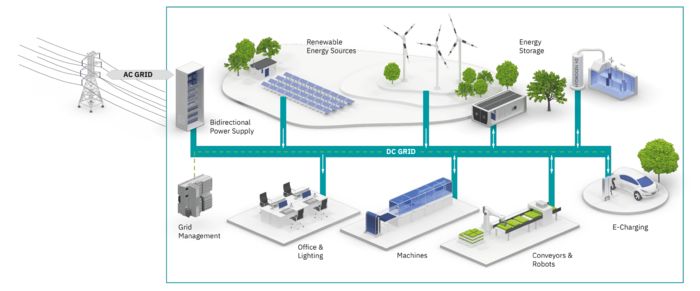
Today, many end devices are already supplied with direct current (DC). EV charging stations and electric drives in industry also work with direct current. Renewable energy sources such as wind and solar also generate direct current. In a traditional AC grid (alternating current), this results in many unnecessary AC-DC conversions, which cost energy. In a DC grid, direct current is fed in, stored, and used directly by loads such as machines, motors, and conveyor belts without being converted to AC. This minimizes conversion losses. In addition, braking energy, for example, can be retained within the grid and peak loads can be reduced. This significantly increases energy efficiency and reduces the feed-in power by up to 80%.
The idea is that the direct current generated by renewable energy sources directly supplies the loads in the grid – such as machines, motors, and conveyor belts – with electricity and thereby reduces conversion losses.
Due to networking in the DC grid, it is also possible to feed the braking energy of a system back into the grid as electrical power. Surpluses produced are collected in energy storage systems and fed back into the grid when necessary. This reduces the feed-in power by up to 80%. In addition, both the peak load and the load on the public grid can be reduced.
Advantages of a DC grid
Increased energy efficiency through energy recovery, reduced conversion losses, and the use of renewable energy, and energy storage
Resource optimization through up to 55% less copper consumption, reduced equipment costs, and smaller footprints
Avoidance of production downtime due to failures in the supply network
Basis for the intelligent control of energy flows
The DC grid in industry at a glance
Solar power
Photovoltaic systems are important generators of renewable energy. They produce direct current and can therefore be integrated efficiently into a DC grid without the need for conversion to AC. We will be happy to advise you on all aspects of feed-in management, photovoltaic applications, and surge protection for rooftop PV systems.
The energy from wind turbine generators can be fed into a DC grid from the DC intermediate circuit via DC/DC converters. Coupling via an AC grid is no longer necessary.
Find our solutions for wind turbine generators, modular condition monitoring, and lightning monitoring here.
The bidirectional connection of EV charging stations to a DC grid enables vehicle batteries to be charged efficiently and also to be used as energy storage systems for short periods.
As a manufacturer of DC charging technology, Phoenix Contact supplies components for the development and installation of DC charging stations for electric cars.
Surplus energy from solar systems and wind turbine generators can be used efficiently through electrolysis to produce fuels (power-to-fuel), hydrogen and methane (power-to-gas), ammonia and methanol (power-to-liquid), and other chemicals. These substances are in turn used to generate electrical energy and thus take on the role of energy storage. Energy storage systems ensure stability in DC grids. Electrolysis is also based on direct current, which makes it expedient to integrate power-to-X systems into a DC grid.
Find out now about components for monitoring, automating, and digitalizing electrolysis.
Many office communication devices, such as PCs and displays, as well as LED lighting technology, require DC voltage internally. Power supply units with rectification and DC intermediate circuits are required to connect these loads to an AC grid. However, if these loads are integrated into a DC grid, a significant part of the input circuit of the power supply units can be saved. This saves on components, weight, and volume.
DC motors are considered as drives in DC grids. However, the three-phase motors that were previously used can also be integrated efficiently into a DC grid through the DC intermediate circuit in frequency converters. This reduces peak loads, particularly in the case of powerful robots and conveyor belts. In addition, the braking energy in a DC grid can be recovered efficiently through recuperation.
Battery storage systems are used for grid support in DC grids. Surplus energy can be stored and made available when needed. Integrating energy storage systems also reduces peak loads, for example when starting up large machines, and relieves the burden on the public supply network. The connection is even more efficient with DC-coupled battery storage systems.
With a bidirectional connection to the AC grid, it is possible to feed power from the AC grid into the DC grid, and to feed surplus energy from the DC grid into the public supply network.
Grid management
Efficient grid management enables the intelligent control of energy flows. By analyzing data, bottlenecks can be identified and avoided. This helps to ensure optimum use of the available energy.
FAQs: DC technology
The industrial sector is looking for suitable solutions to achieve climate targets. Rising energy costs, a shortage of resources, and an increasing demand for energy are posing new challenges for industry. One approach to facing these challenges is to switch from an AC power grid to a DC grid. Renewable power generation, energy storage, and energy recovery are keywords that can be implemented in a DC microgrid. This reduces energy consumption and cuts peak loads (peak shaving). The effect relieves and stabilizes the supply network. Designing DC grids for industry is one approach toward sustainable industrial production.
In a DC-based microgrid, electric power is generated through the efficient integration of renewable energy from carbon-neutral production. This energy is used by electrical loads in a DC grid directly, without further conversion from DC to AC. This saves conversion losses and reduces energy consumption. In addition, the entire braking energy from lifting processes, which would otherwise be lost in the form of heat, can also be used. Instead, the braking energy is fed back into the DC grid as electrical energy. Energy storage systems collect excess DC power for later use. As a result, a combination of sustainable power generation, energy recovery, and energy storage ensures greater sustainability and increased energy efficiency in factories.
In addition to savings in energy consumption, using a DC grid also results in potential material and space savings.
Energy losses can be reduced by approximately 6% to 8% through the elimination of DC-AC conversions. In addition, the use of suitable energy storage leads to a reduction of feed-in power from the public grid by up to 80%. The complete use of braking energy also enables 15 to 20% more energy savings, depending on the application. Due to these factors, the energy efficiency in DC grids increases significantly compared to AC grids.
The potential in terms of material and space savings is also considerable. In DC grids, up to 40% of the copper and insulation material used can be saved while maintaining the same performance. In times of scarce resources, this is significant. DC devices are also significantly smaller than AC devices. The reduced material expenditure saves further space.
The conversion of direct current to alternating current or direct voltage to alternating voltage involves losses, since energy is also required for conversion. This increases energy consumption, and energy efficiency suffers as a result. In addition, DC-AC inverters are necessary. They require corresponding space in the application – space that is saved by not converting.
Supplying direct current straight to loads replaces the previous DC-AC-DC conversions. This increases energy efficiency, as a purely DC grid typically consumes 6 to 8% less energy than an AC grid. Further savings are possible through the use of braking energy and immediate storage of direct current.
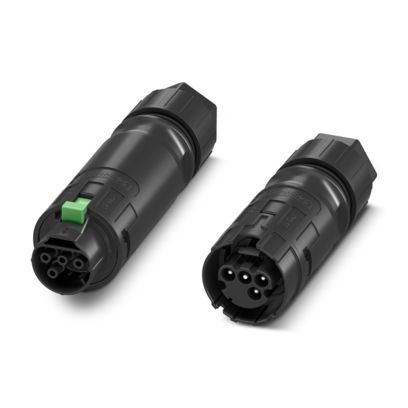
In DC applications, electric arcs can damage contacts and housing parts and, in the worst case, also pose a hazard to users. Under these circumstances, a new approach to the development of components is required. Various technologies for DC connectors have been developed by Phoenix Contact in research projects. With extinguishing technology in connectors, an innovative approach has now been developed that protects components and their users from the dangers of electric arcs.
We trust in DC grids
Phoenix Contact is an expert partner for the use of DC grids in industry
As one of 39 partners from industry and research, we were also part of ZVEI’s DC-INDUSTRIE 2 research project, which was funded by the German Federal Ministry for Economic Affairs and Climate Action. Naturally, Phoenix Contact is also involved in the resulting ODCA (Open Direct Current Alliance), as a founding member and board member.
With regard to the necessary energy transition in industrial production and the associated maximum use of renewable energy, the working group has set itself the goal of supplying production facilities with direct current in an efficient, safe, and robust manner.
Phoenix Contact is involved in national and international task forces and is conducting intensive research on the use of industrial DC grids in the field of factory automation with a focus on future-proof electrical installations. One of the central topics that Phoenix Contact is dealing with, for example, is the avoidance of electric arcs in the DC connector sector.
From theory to practice
DC grids in production and in buildings
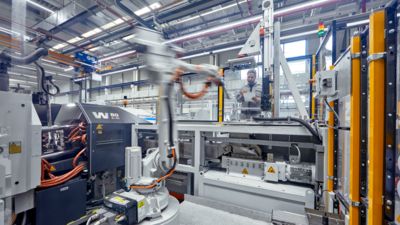
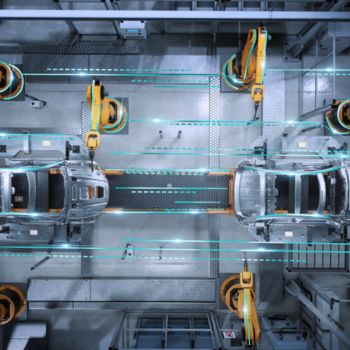
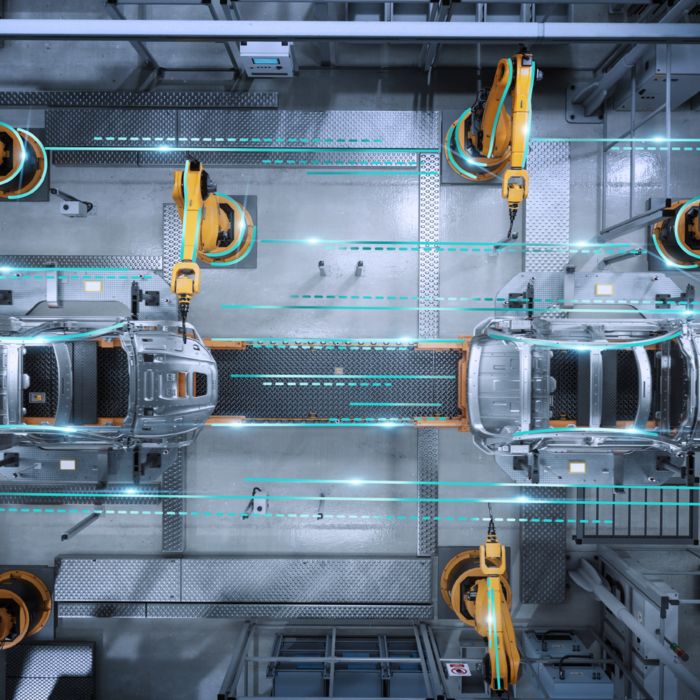
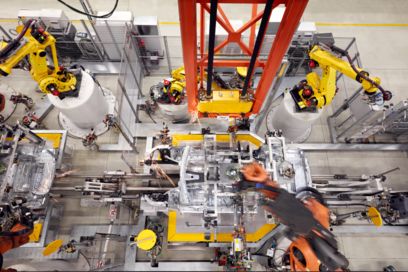
Phoenix Contact is going even further, however, because research alone is not enough for us. As an innovation leader and expert in electrical installation, we wanted to take the first step, be present, gain experience, and solve problems. One promising area of application for DC grids is the field of automotive production. When one of our partners in the ODCA planned to install a DC grid as a pilot system, we were able to provide quick support with our DC-capable components.
We have also installed a DC grid in our new building, the All Electric Society Factory, on our own campus in Blomberg. In doing so, we have created a blueprint for industrial DC grids, from planning right through to the finished installation. Naturally, we are trusting in our own products and developing further DC-capable components as part of the project. Through continuous research and further development of our products and solutions, we are able to create a sustainable and efficient power supply that meets the requirements of modern industry.
And of course, the technologies and solutions installed in the All Electric Society Factory are also available to our customers in our drive to empower the All Electric Society.
Rethinking data centers: with direct current
Energy-efficient, scalable, and ready for green data centers
Data centers are huge energy consumers and are under pressure: increasing energy requirements, high carbon emissions and rising costs. With DC grids, Phoenix Contact provides an innovative solution to increase efficiency, sustainability, and the security of supply. Fewer conversion losses, better integration of renewable energies, and reduced carbon emissions are just some of the advantages. Discover how our DC components are paving the way toward green data centers.