Hydrogen emergency power supply for traffic tunnels with H2 Powercell GmbH Implementation of a fuel cell-based emergency power supply in the Mosi Tunnel in Switzerland based on our open automation platform. The PDF, documenting the complete customer reference, provides in-depth technical insights.

Customer profile

Fuel cell systems for critical applications
- H2 Powercell GmbH, based in Emsdetten, Germany, develops, produces, and sells modular fuel cell systems for the reliable generation of electricity and heat.
- The focus is on modular hydrogen solutions for private, commercial, and industrial applications that combine sustainability and cost-effectiveness.
- With products such as the H2 PowerCube and H2 SecurePower, H2 Powercell GmbH provides pioneering technologies for a carbon-neutral power supply.
The challenge

Reliable power for safety-critical systems
The emergency power supply in the Mosi Tunnel must reliably protect safety-critical systems in the event of a power failure. These systems include the signal technology, emergency lighting, and all data communications needed for shutting the relevant systems safely when necessary. This requires a peak output of 8 kW. The system is designed to provide an average output of 7 kW for more than 20 hours.
In addition to the required power capability, the project also included other requirements. This included high system availability through redundancy at the fuel cell stack level. It was also necessary to integrate the entire system into one compact control cabinet. In addition, the system had to be designed such that it could be subsequently extended to double the peak output while retaining the same buffer time.
The solution
In the video, project participants provide insights into the implementation of the emergency power system in the Mosi Tunnel and demonstrate how open automation and hydrogen technology can work together to create safety.

Integrated, compact, and scalable
In the event of a malfunction, the solution enables the controlled and safe shutdown of tunnel operations. Safety-relevant functions such as signaling devices, emergency lighting, and the ventilation of evacuation routes remain reliably available.
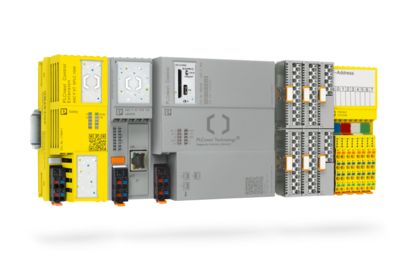
The integrated control concept replaces several previously separate PLC systems. Now, the central AXC 2152 PLCnext Control manages all the control and monitoring functions. This reduces the interface and coordination effort, speeds up commissioning, and increases operational safety.
It is possible to create a space-saving, modular solution in conjunction with Axioline Smart Elements (I/O modules). Additional signal inputs/outputs and more controller power can be retrofitted easily when required without changing the system architecture. The platform is aligned with IEC 62443 and thus fulfills essential cybersecurity requirements in critical infrastructures.

Contact

Products

Still haven’t found the right product?
Feel free to contact us. Together, we will find the ideal solution for equipping your control cabinets with our range of over 100,000 products from the fields of connection, communication, and automation technology.
Summary

Technological basis for future emergency power concepts
The Mosi Tunnel project demonstrates that fuel cell-based emergency power systems are a powerful and sustainable alternative to classic diesel generators.
We are creating the technological basis to reliably implement new energy concepts using the open PLCnext Technology automation platform. This platform makes a decisive contribution to reducing system complexity, increasing operational safety, and making sustainable emergency power solutions economically viable.
The system is an important building block because it enables the tunnel operator to gain experience of hydrogen technologies. At the same time, it forms a resilient basis for future projects in which sustainability and security of supply go hand in hand.