Heated chambers are used in a wide range of industrial applications, including baking, curing, drying, and heat treatment. Compared to kilns, they operate at lower temperatures. This enables energy-efficient and reliable processes. Typical areas of application include the electronics, pharmaceutical, and food industries. Precise temperature control, uniform heat distribution, and reproducible processes are crucial in this context. Thanks to their flexible design, these ovens can be optimally adapted to different product requirements and throughput quantities.
Industrial thermoprocessing equipment Comprehensive automation solutions for safe and sustainable thermal processing technology
Fields of application
Thermal processes as the basis for energy-intensive industries
Industrial thermal processing technology is used for the targeted modification of material properties through the use of thermal energy. It forms a central basis for modern production and finishing processes. The range of applications extends from low-temperature processes of up to 750°C through to high-temperature processes that go beyond 750°C. It is therefore indispensable for numerous industries, including chemicals, pharmaceuticals, glass, steel and cement, food and building technology. Decarbonization is at the heart of future-proof thermal processing equipment. This is made possible by intelligent, scalable, and modular software-controlled automation solutions that can be flexibly adapted to industry-specific requirements. State-of-the-art control technology, stable communication infrastructure, integrated functional safety, and high-performance connection technology create the basis for energy-efficient, safe, and long-term competitive thermal processing technology.
Melting tanks, melting furnaces, and blast furnaces form the backbone of many high-temperature processes, such as the melting, refining, and thermal treatment of metals and glass. These systems operate at extremely high temperatures. They enable precise and reproducible process control over long periods of time. The focus is on requirements such as process stability, energy efficiency, and operational safety. Their areas of application range from metallurgy to the glass and ceramics industries and other energy-intensive industries. These industries place high demands on temperature control and system availability.
Typical applications include steam boilers, hot water boilers, and steam pressure boiler systems. These closed pressure vessels enable the targeted heating of water or other media to provide process steam or hot water for industrial applications.
The steam generated is used for both thermal process control and electricity generation. Applications range from power stations and the chemical process industry to food production.
The challenges
Thermal processing technology in need of transformation
OEMs of industrial ovens and furnaces, melting tanks, boilers, burners, and combustion systems are facing a profound transformation worldwide. Rising energy and CO₂ costs are putting increasing economic pressure on machine concepts and system operation. At the same time, regulatory requirements such as environmental regulations, the safety of machinery (Machinery Regulation), and regulations like the CRA and NIS 2.0 are tightening the requirements for development, certification, and operation, especially in an international context involving market access in the EU, US, and Asia.
To remain competitive, efficient, and sustainable, companies must contend with high investment costs and increasing pressure to innovate. The focus is shifting increasingly toward the total cost of ownership (TCO): Energy efficiency, availability, maintenance costs, and lifecycle costs are becoming key competitive factors.
At the same time, the shortage of qualified engineering personnel is exacerbating the situation. Development times are getting longer, while at the same time more expertise is required in the areas of automation, software, functional safety, and cybersecurity. OEMs therefore need scalable, future-proof solutions that reduce technical complexity, meet global requirements, and enable sustainable business models.
What we offer
Scalable automation solutions for global OEMs in thermal processing technology
We offer solutions that address the needs of OEMs of industrial ovens and furnaces, melting tanks, boilers, burners, and combustion systems for the global development, standardization, and scaling of systems. The focus is on a modular, open automation platform that can be flexibly adapted to system-specific requirements. Automation, reduced hardware complexity, and standardized modules significantly shorten engineering and commissioning times. Machine concepts can be scaled and used worldwide. This is a decisive advantage for OEMs with access to the EU, US, and Asian markets. Reliable solutions ensure stable system operation even under demanding conditions. When combined with integrated diagnostics, they enable higher system availability, transparent status information, and rapid fault analysis – both locally and remotely. Remote maintenance and centralized device and patch management lay the foundation for efficient servicing and secure updates throughout the entire lifecycle. Our solutions can be seamlessly integrated into existing IT/OT environments and modern data architectures. They form a future-proof basis for the gradual modernization of existing systems. Safety and security are integrated from the outset: Functional safety and cybersecurity are addressed holistically and support compliance with international standards and regulatory requirements. This allows OEMs to keep complexity, risks, and total cost of ownership (TCO) under control while maintaining a high level of innovation.
Our points of focus at a glance
- Maximum availability and reliability
- Stable processes and a unified system architecture for the EU, US, and Asia with robust, proven signal, measurement, and communication technology, as well as smart performance monitoring and precision control
- Long-term scalability
- Significantly shorter development and commissioning times – achieved through standardized hardware, reusable software libraries, and modular concepts – ensure the efficient transfer of functions (once developed) to new systems and applications
- Energy efficiency and sustainability
- Maximum transparency and reduction of energy consumption and carbon emissions through IIoT ecosystems, adaptive and highly available measurement and control technology, as well as AI-supported process optimization
- Rethinking safety: automated and integrated
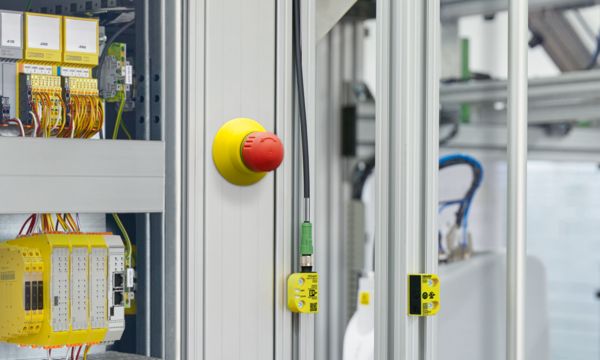
- Operational safety through end-to-end monitoring, flexible scalability, and seamless automation with digital, standard-compliant safety concepts (IEC 61508, NFPA, ISO) for burners, ovens and furnaces, and boilers
Platform-based process automation for industrial process heat
Our Industrial Thermoprocessing Equipment (IThE) platform is a software-based, open, and scalable solution for the automation of thermal processes. It provides a unified foundation for burners, ovens and furnaces, drying and hot air applications, as well as for electric and hybrid heating processes, regardless of the system size or industry. IThE enables consistent and future-proof process automation from development through to modernization. Instead of project-specific, one-off solutions, the platform focuses on platform-based process automation. A unified software basis enables a high degree of modularization and reusability. This significantly reduces engineering effort while shortening time to market. At the same time, the clear separation of standard and application-specific logic ensures transparency, scalability, and long-term maintainability. Phoenix Contact supports OEMs, integrators, and operators with everything from application and architecture consulting to standards, safety concepts, and system design, as well as modularization, retrofitting, and digitalization.
Navigate through the graphic to find out more about our fields of application for the automation of industrial thermoprocessing equipment. Click on the various areas for further information.
Products
Norms and standards
Foundations of quality and safety
In the field of industrial thermal processing technology, norms and standards are far more than just regulatory requirements. They are the foundation for safe, efficient, and high-quality systems. These norms and standards bring clarity to the operation, maintenance, and communication of technical systems and form the basis for sustainable innovation.
Internationally established regulations apply for applications in the low and high temperature range. These include the EU Machinery Regulation with the product standard ISO 13577-2/4 (formerly EN 746-2), EN 50156-1/2, and the North American standards NFPA 85, 86, and 87. In an increasingly networked processing world, digital security standards such as IEC 62443 and the NIS 2 Directive are coming into the spotlight. They not only enable protected remote access to critical systems, but also seamless integration with digital platforms such as Proficloud.io. Functional safety and industrial cybersecurity are inextricably linked. An industrial oven or furnace is only safe if its digital environment is also protected. Secure operations can only be achieved with cybersecurity.
The combination of technical standards and digital standards enables location-independent diagnostics, automated update management, and comprehensive performance monitoring. This results in maximum system availability and minimal downtime, and represents a clear step toward smarter and safer process heat.
Proven safety and conformity
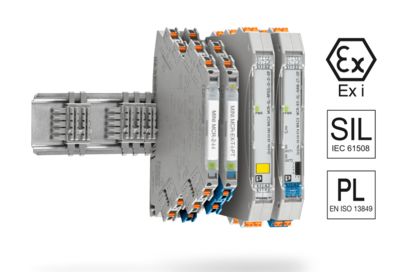
Phoenix Contact offers tested automation and safety solutions for industrial thermoprocessing equipment. Independent TÜV certification confirms that safety-related functions have been implemented in accordance with standards. The TÜV certification covers, among other things, the AXL F PSAI8 I 1 F and AXL F PSRTD8 1 F safety-related modules. They are designed for use in safety-related measurement and monitoring functions in thermoprocessing equipment.