Device Description
What you will find in this section:
Device description
The EMpro energy measuring devices (EEM-MA..., EEM-MB... types) are universally deployable, high-precision, network-compatible measuring devices with LC display, which can measure, evaluate and process voltages and currents in one, two and three-phase power supply systems. You can use EMpro energy measuring devices in TN and IT systems.
For voltage measurements, up to four inputs are available; for current measurements, up to three inputs are available. Currents can be measured with current transformers (EEM-MXXX0) or Rogowski coils (EEM-MXXX1). If you use Rogowski coils, you do not need an external measuring transducer. EMpro energy measuring devices can be connected directly to Rogowski coils from any manufacturer. Voltages can be measured directly, or by means of voltage transformers.
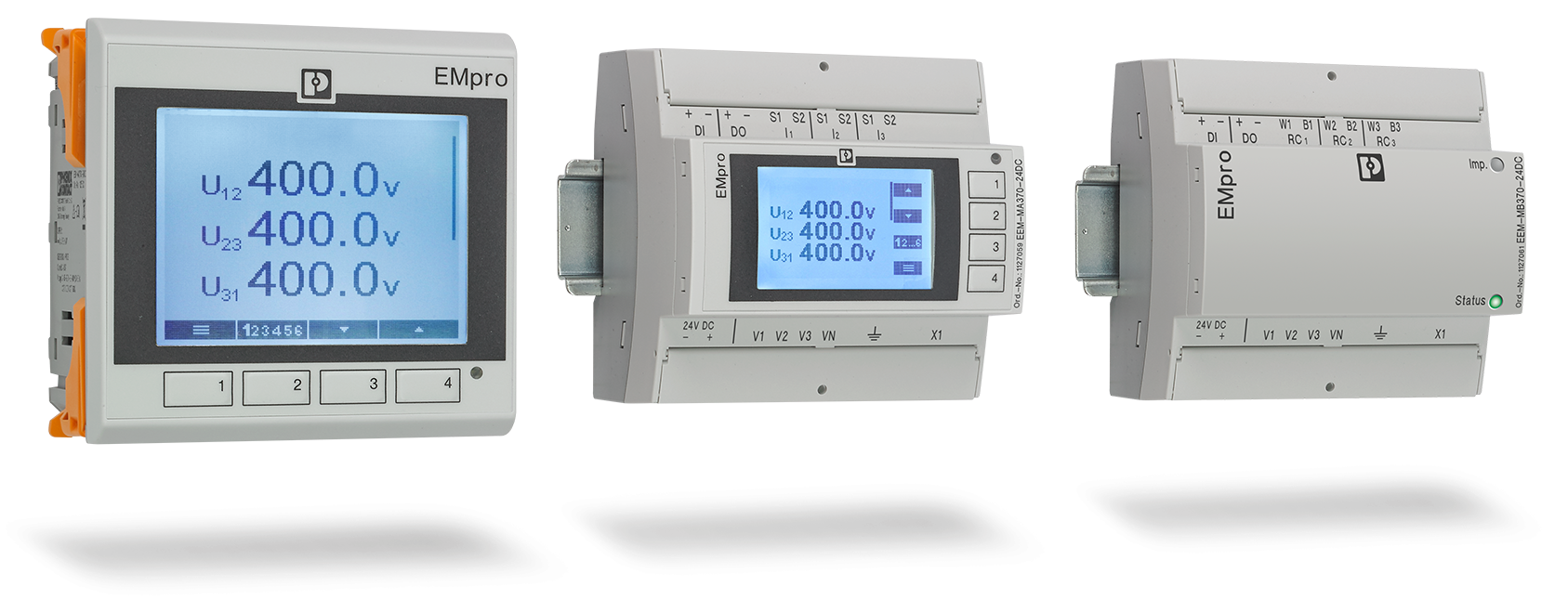
To enable versatile use, EMpro energy measuring devices are available for the following installation methods:
- For front panel installation or with DIN rail adapter, with LC display, with control buttons
- For DIN rail installation, with LC display, with control buttons.
- For DIN rail installation, without LC display, without control buttons.
 If you use a DIN rail adapter (EEM-MKT-DRA, Order Number 2902078), you can mount EMpro energy measuring devices for front panel installation on a 35 mm DIN rail.
|
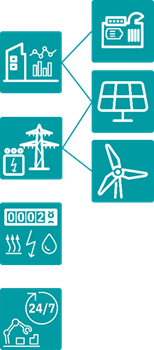
Applications: Energy monitoring for building automation systems:
Monitoring of distribution grids:
Commercial Submetering:
Power monitoring in industrial environments:
|
 |
| Your advantages: | |
|
 |
|
|
|
 |
|
 |
|
 |
|
 |
| Measurement data acquisitions: | |
Numerous parameters that are important for operating an electrical system are determined by means of the voltages and currents measured by the EMpro energy measuring devices. Features:
- Calculation of TRMS values (seamless)
- Measurement of most relevant electrical parameters in 50/60 Hz AC grids
- Measurement of 1st to 63rd harmonics for voltage and current and formation of THD
- Measurement of minimum, maximum and average values (including minimum average and maximum average values)
- Measurement of active, reactive and apparent power in all four quadrants (consumption, supply)
- Load type according to IEEE or IEC standard
- Calculation of system voltages and currents (average over all phases)
- Energy meter total and energy meter resetable (active energy, reactive energy and apparent energy)
- Four tariff energy meter resetable (active energy, reactive energy and apparent energy)
- Impulse counter to detect consumption of any media via the digital input
- Operating hours counter, which counts if load exceeds a threshold value (default: > 100 W)
- Process energy counter, which counts energy controlled by the user (active energy, reactive energy and apparent energy)
The following measurement values/parameters are shown on the LC displays and in the web server of EMpro energy measuring devices:
- Voltage U [V] (L-L, L-N)
- Current I [A]
- Frequency f [Hz]
- Active power P [W] (string, total)
- Reactive power Q [var] (string, total)
- Apparent power S [VA] (string, total)
- Power factor PF, λ
- Active power factor, active factor cos Φ
- Phase shift angle, phase angle Φ (U-U, U-I)
- Rotary field RD
- Total harmonic distortion (ratio) of the voltage, THD U (L-L, L-N)
- Total harmonic distortion (ratio) of the current, THD I
- Harmonics (ratio) of the voltage, H U (L-L, L-N)
- Harmonics (ratio) of the current, H I
- Energy E [Wh, varh, VAh] (consumption, supply, meter total/resettable)
- Energy tariff meter E [Wh, varh, VAh] (consumption, supply, meter 1-4)
For the measurement values/parameters voltage U (L-L), U (L-N), current I, frequency f, active power P, reactive power Q and apparent power S, it is possible to switch between:
- Instantaneous = Instantaneous value
- Min = Minimum value (can be reset)
- Max = Maximum value (can be reset)
- AVG = Current average value
- AVG Min = Minimum average value (can be reset)
- AVG Max = Maximum average value (can be reset)
Up to 8 freely configurable parameters can be logged internally on the EMpro energy measuring device and 8640 values (90 days with 15-minutes recording interval) can be saved per log.
All the measures described above are also available via the web server that has been integrated into the EMpro energy measuring device. In the web browser, the data cannot only be displayed numerically, but also in the form of a convenient analog display with trend charts.
| Measuring accuracy: |  |
The accuracy class of the device depends on the current input (current transformer / Rogowski coil) and the device version (higher accuracies due to optimized hardware from FW version 2.0.0).
The accuracies of the device are stated in Reference information in the subchapters
- Technical Data
- Specifications according to IEC 61557-12
| Monitoring functions: | |
- Monitoring of 4 freely configurable parameters and alarming in the event of a violation of an upper or lower limit
- With display color change by alarm and linking of alarms with EMpro internal logic gate
- Determination of power trends for detecting and predicting upcoming peak loads
- Permanent storage of extreme values (min, max) and storage of the associated time stamps
- Determining the direction of the rotating field
- Detection of voltage dips, voltage swells and voltage interrupts based on IEC 61000 - 4 - 30
| Operating and indication elements: | |
When EMpro energy measuring devices with LC display are used, it is possible to locally display measurement values and perform configuration tasks locally by means of 4 buttons. Events are displayed in the status bar of the device via icons. Additionally a pulse LED in the front of the measuring devices indicates the positive active energy (demand). All EMpro energy measuring devices have an integrated web server. This can also be used to display all relevant measurement values and parameters and to configure the energy measuring device. In the web browser, the data cannot only be displayed numerically, but also in the form of a convenient analog display with trend charts.
Here you can get an impression of the display and setting options: Discover virtual webserver
Embedded tools and services:
- Installation assistant
- Firmware update function
- Export, import and direct transfer of configuration data
- Display color changes (white to red) by alarms
- Online search of registers to quickly find the right information required for setting up communication.
| Communication interfaces: | |
A variety of hardware and software interfaces can be used to communicate with higher-level control systems. The following interfaces are available:
- BACnet MS/TP (RS-485)
- Modbus/RTU (RS-485)
- BACnet IP (Ethernet)
- Modbus/TCP (Ethernet)
- REST API (Ethernet)
- MQTT (Ethernet)
- PROFINET (Ethernet, Dual Port)
- EtherNet/IP™ (Ethernet, Dual Port)
- Proficloud (Ethernet, Dual Port)
Modbus TCP and REST API communication interfaces come native on all EMpro models. The appropiate article or firmware version must be selected for the other listed interfaces. EMpro versions with an RS-485 interface can optionally be operated in Modbus gateway mode.
One multifunctional digital input and one multifunctional digital output are available.
| Security: | |
Phoenix Contact offers products and industry solutions with cyber security functions for the future-proof operation of machines, systems, and infrastructures. To protect these it is necessary to implement and continuously maintain a holistic cybersecurity concept. Security provided by the EMpro energy measurement device constitutes therefore only part of an overall concept.
Features:
- A PIN entry protects the EMpro against improper use. Write access using the control buttons on the device and the Modbus interface is blocked if the incorrect PIN is entered.
- The other interfaces that allow write access (REST API & BACnet) can be set to “read-only” mode (password protected)
- All interfaces can be deactivated individually. The users are responsible for securing their networks against unauthorized access.
- A deactivation of control buttons for configuration is possible
- The web server of the EMpro is password protected. Write access using the web server is blocked if the incorrect Password is entered.
- A deactivation of the web server or setting the webserver to “read only mode” is possible
- Sealable connection fields prevent unauthorized opening of the screw terminal blocks
- Firmware uptdates optimize the performance and expand the functionality of EMpro and aim at future-proof operation
Related topics